Month: November 2024

Treasure Island

29/11/24

Lyceum Theatre, Edinburgh

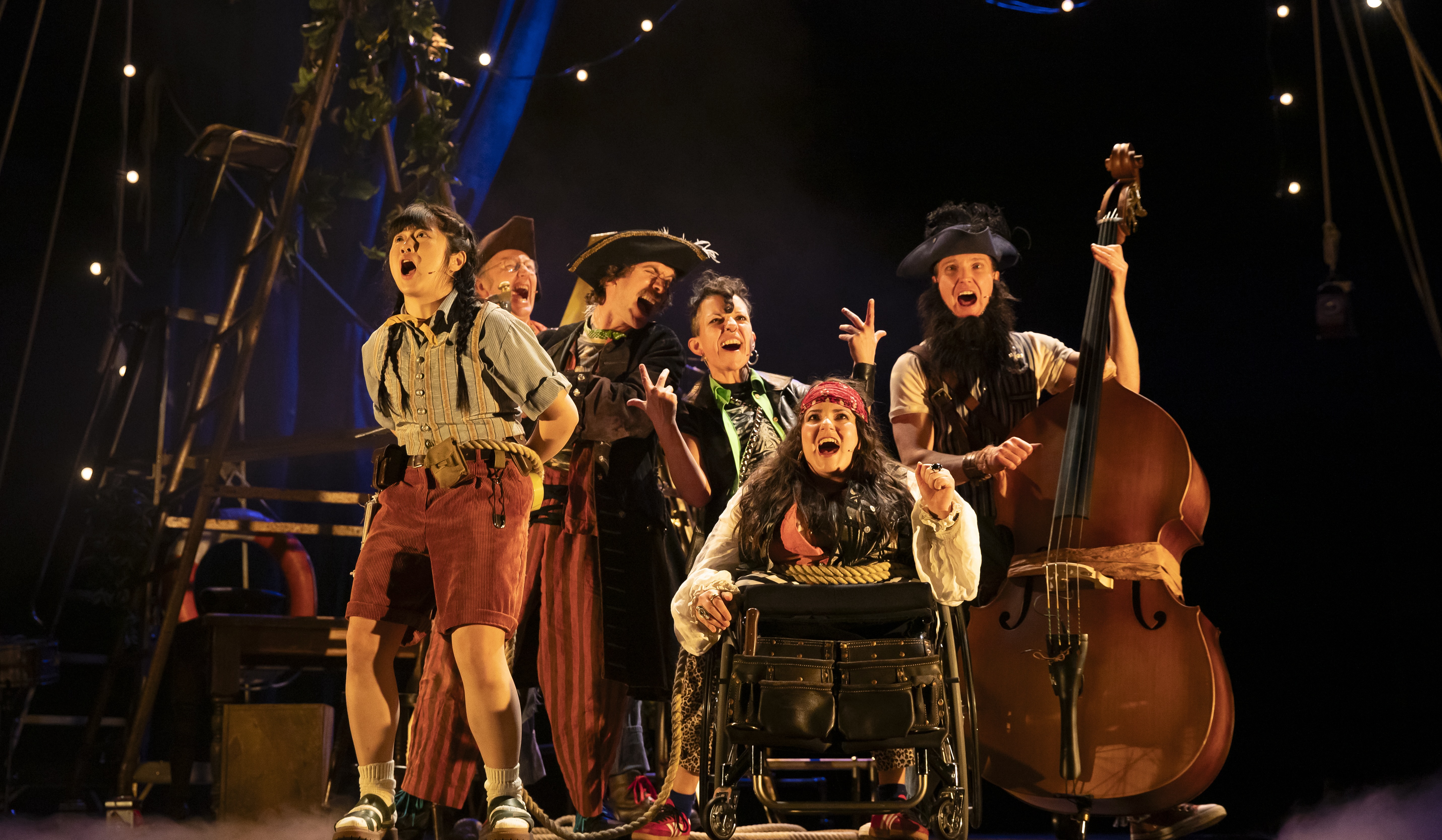
A satisfying Christmas show can be a decidedly tricky thing to pull off. If Robert Louis Stevenson’s Treasure Island initially seems an unlikely vehicle for such a venture, my qualms are short-lived. Duncan McLean’s sprightly adaptation of the classic tale is perfectly pitched for family entertainment. It sticks surprisingly close to the original plot, but throws in enough delightful twists to make me forget that I’ve heard this story so many times before.

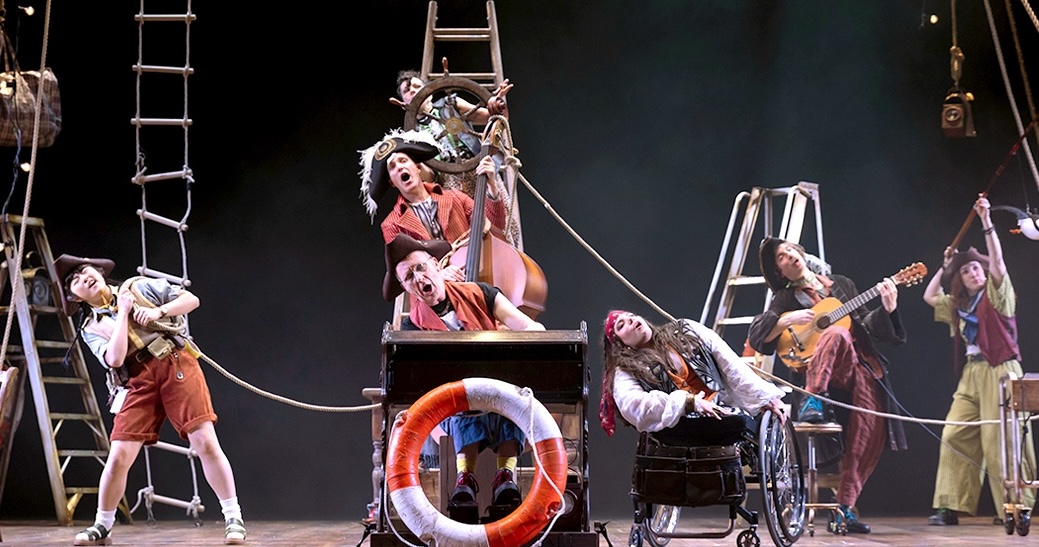
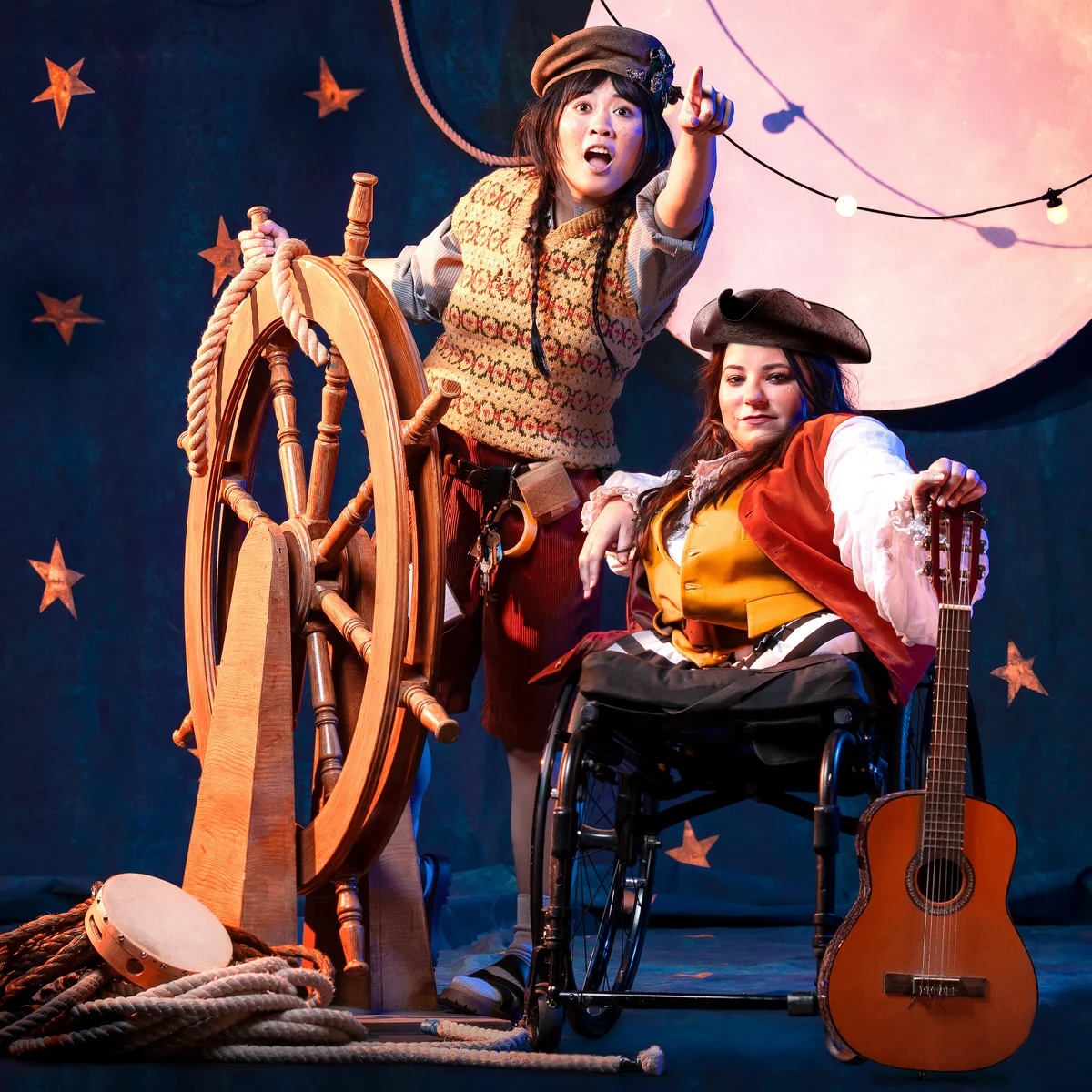
The tale begins in the Admiral Benbow Home for Reformed Pirates. It’s coming on Christmas and young Jim Hawkins (Jade Chan) is attempting to keep the unruly residents (a pack of former cut-throats) suitably entertained with a story. But it turns out that ex-buccaneers take a dim view of books about macrame and bird-spotting, so Jim reluctantly offers to recount the events that brought them all together in the first place. It helps that the pirates have plenty of talents they can bring to bear in the telling, not least the fact that they can all sing, dance and bash out tunes on a variety of musical instruments.

The story begins in time-honoured fashion with the arrival of Billy Bones (Itxaxo Moreno) at the Admiral Benbow and, of course, the delivery of the dreaded Black Spot – and it isn’t long before Jim has possession of the fabled treasure map. He enlists the help of The Laird of Leith (a delightfully silly performance by TJ Holmes), who owns a ship called The Hispaniola. The Laird engages the services of a pie-maker called Lean Jean Silver (Amy Conachan), who has a pet puffin (expertly operated by Dylan Read). But Lean Jean may not be as benign as she appears…

The main changes to the story are geographical. McLean is based in the Orkney Islands so, in this version of the story, the Hispaniola heads North, towards colder waters. Alex Berry’s effective set design manages to somehow encapsulate the look and feel of an old sailing ship using not much more than ropes, rigging and strategically-placed stepladders, while everyday objects are pressed into service to become boats and aquatic creatures. Director Wils Wilson expertly deploys the small cast, sending them racing and capering over every inch of the Lyceum’s spacious stage, assisted by piratical-looking stage hands. At times, it feels like there’s a much bigger crew at work.

There are sword fights and chases, thrills and spills aplenty, and Tim Dalling (who also plays an engaging Ben Gunn) has written a selection of charming songs to accompany the action, ranging from plaintive ballads to raunchy rock-and-roll.

If only he had a singalong Christmas ditty up his sleeve, something to send every audience homewards singing the chorus. Oh wait, it turns out he has.

Treasure Island is a must-see for the festive season – you’ll laugh, you’ll tremble, you’ll tap your feet to the jaunty jigs and reels – and even the youngest members of the family will find themselves riveted. So step right this way, ye scurvy dogs – and have a merry puffin Christmas!

4.6 stars

Philip Caveney
My Old Ass

26/11/24

Amazon Prime

Maybe because it’s lumbered with what must rank as one of the most unprepossessing titles in cinematic history, this charming film failed to make it into UK multiplexes and can only be found lurking amidst the ‘recently added’ section on Amazon Prime. Written and directed by Megan Park, it’s an engaging story, anchored by a tremendously appealing central performance by Maisy Stella.

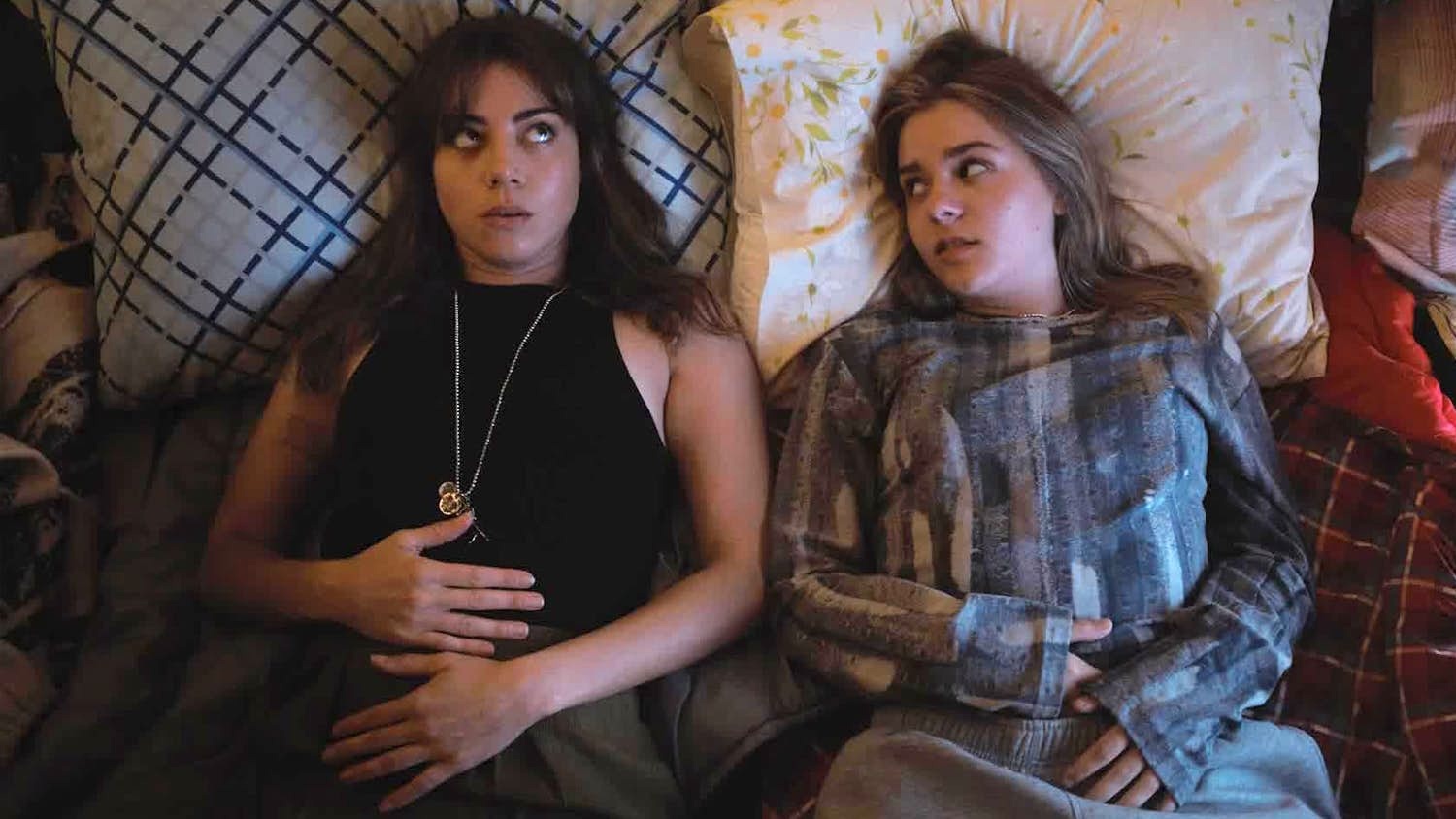
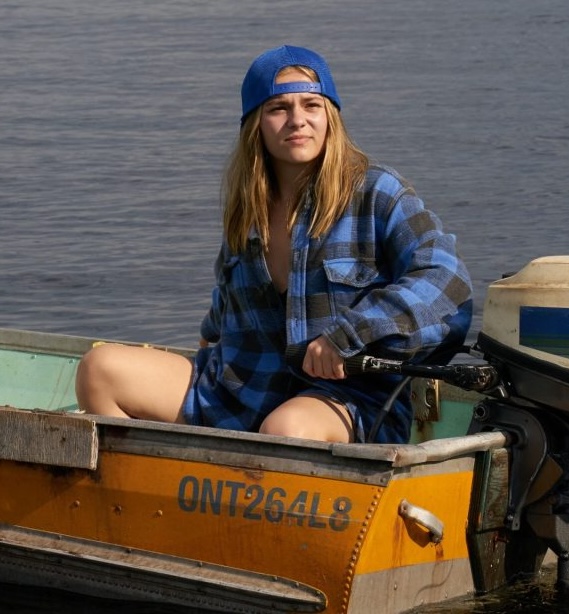
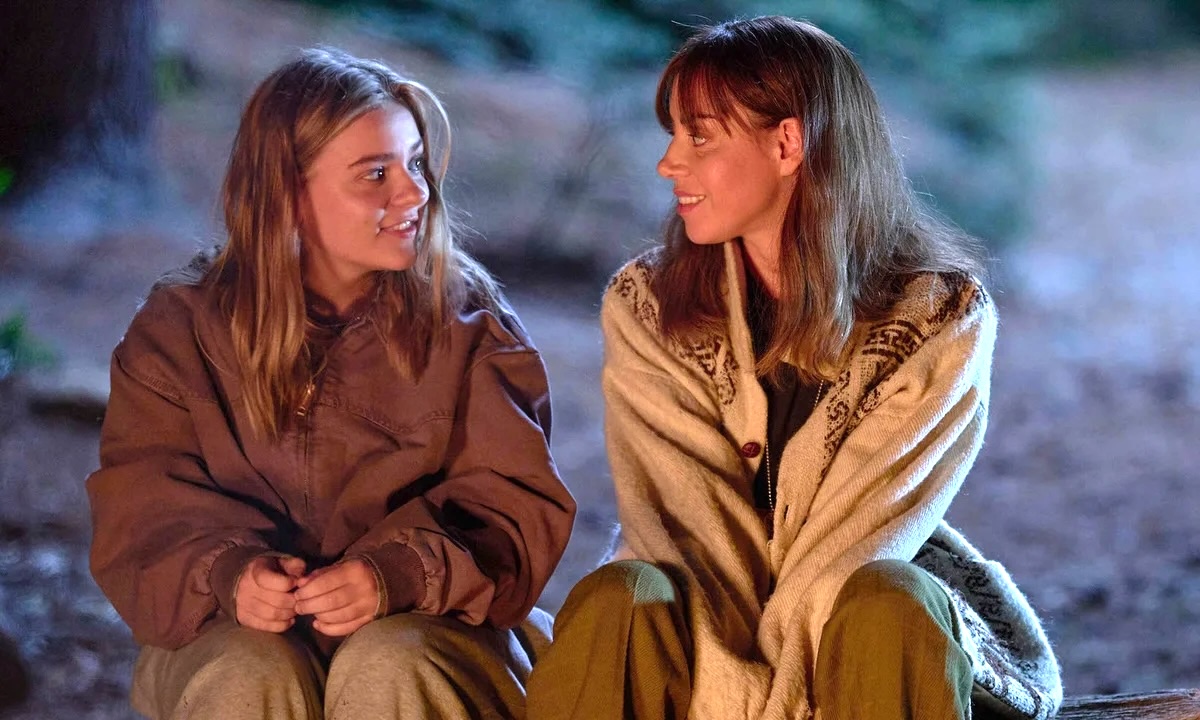
She plays Elliott, a teenage girl living in the wilds of Canada. She’s recently finished school and is preparing to head off to university in Toronto. Meanwhile, she’s intent on enjoying her remaining days at home: making out with an attractive female assistant at her local coffee shop (an ambition that’s quickly ticked off the ‘to do’ list), and then heading off with her two pals, Ruthie (Maggie Ziegler) and Ro (Kerrice Brooks), for an unconventional birthday celebration. The trio have laid their hands on some hallucinogenic mushrooms and plan to spend the night in the local woods, getting utterly wasted. (With typical teenage insensitivity, Elliott is blissfully unaware that her family are waiting at home for her with a birthday cake).

The resulting trip has some unexpected consequences. Elliott encounters a version of herself from the future. Older Elliott (Aubrey Plaza) is thirty-nine, still in college and, judging by the scant information she gives away, living in a dark and unpredictable world. She has only one bit of advice for her younger self. Stay away from somebody called ‘Chad.’ (She refuses to say any more on the subject.)

The following morning, older Elliott has disappeared but she has left her phone number and, it turns out, the two of them can talk to each other across the decades, even exchange text messages. And then young Elliott bumps into a handsome and charming stranger (played by Percy Hynes White) and, despite her previous aversion to boys, she begins to feel powerfully attracted to him.

His name? You guessed it. Chad.

My Old Ass is a charming, bitter-sweet story that celebrates the freedom of youth and, at the same time, points out the futility of trying to deny your inner longings and the inevitability of change. As I said, Stella is tremendous in this and I expect to see her in more movies in the not too distant future. Elliot’s relationship with her mother, Kathy (Maria Dizzla), and her two brothers, Max (Seth Isaac Johnson) and Spencer (Carter Trozzolo), are effectively drawn – I particularly enjoy Spencer’s obsessive preoccupation with the actor, Saoirse Ronan – and the picturesque Canadian settings are beautifully utilised.

Aubrey Plaza makes a welcome addition to any film (she was the best thing about Francis Ford Coppola’s Megalopolis) and my only complaint is that here she’s somewhat underused, popping up only twice in person. But it doesn’t prevent the story from keeping me intrigued and hooked to its charming – and sometimes quirky – worldview.

So, the next time you’re stuck for something new to watch, head to Amazon Prime and give this a whirl. It’s a delight.

4 stars

Philip Caveney
Joy

23/11/24

Netflix

For people of a certain vintage, the name of Bob Edwards might ring a bell. He was, of course, the doctor who came up with the concept of Invitro Fertilisation and who, after years of tireless work, was behind the birth of Louise Brown – the first ‘test-tube baby’ as the press of the era dubbed her. You’ll probably also have heard of Patrick Steptoe, the surgeon whose advances in keyhole surgery made the whole process a possibility.

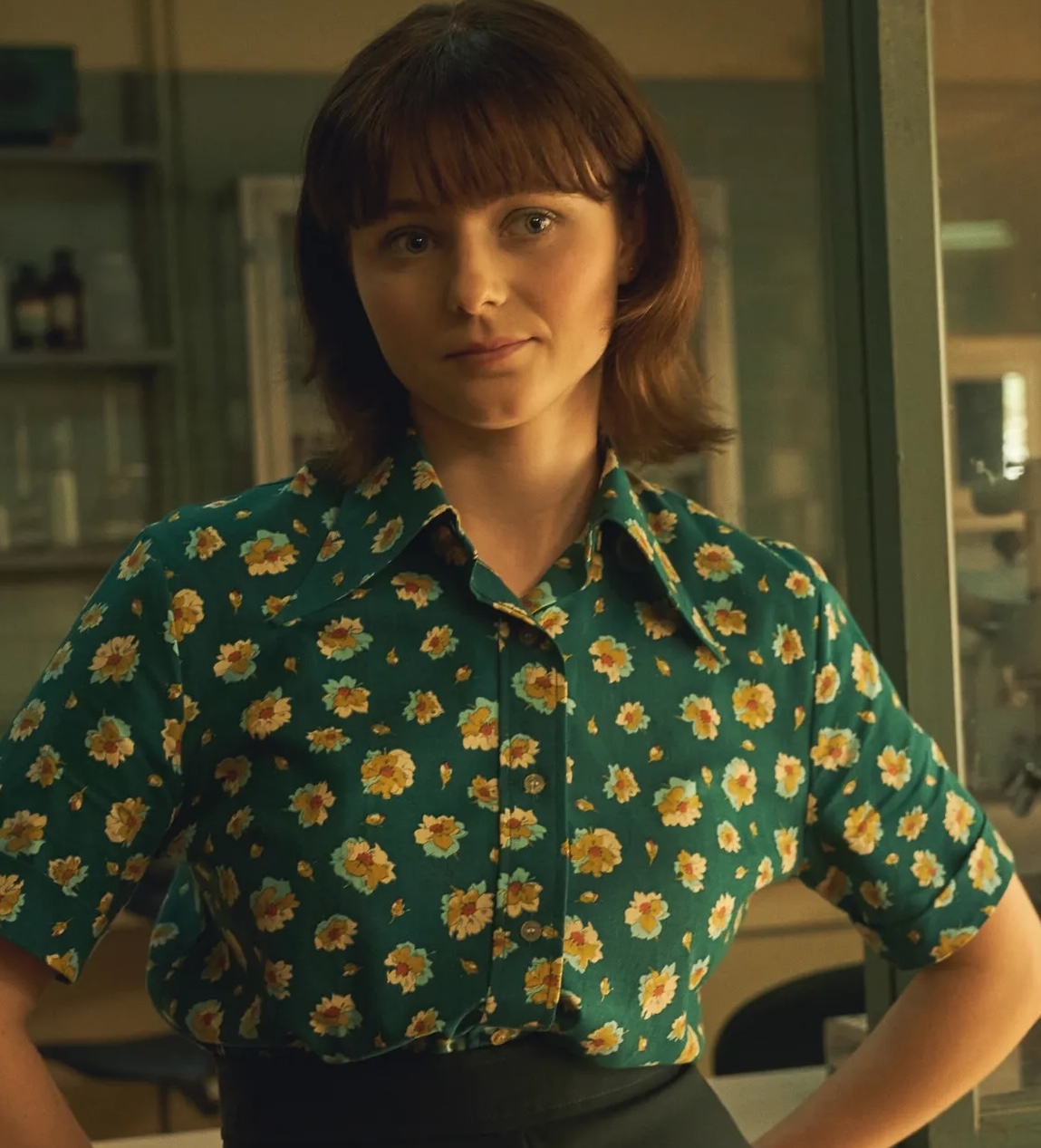
But the name Jean Purdy is certainly not as familiar. The third member of the team, an embryologist, Purdy worked alongside the two men (and, indeed, as this film suggests, was ultimately the driving force that brought their work to completion). And yet, to a great degree, her contribution has been largely airbrushed from history. She didn’t even merit a mention on the memorial plaque at Oldham General Hospital (Louise Brown’s birthplace) until 2015.

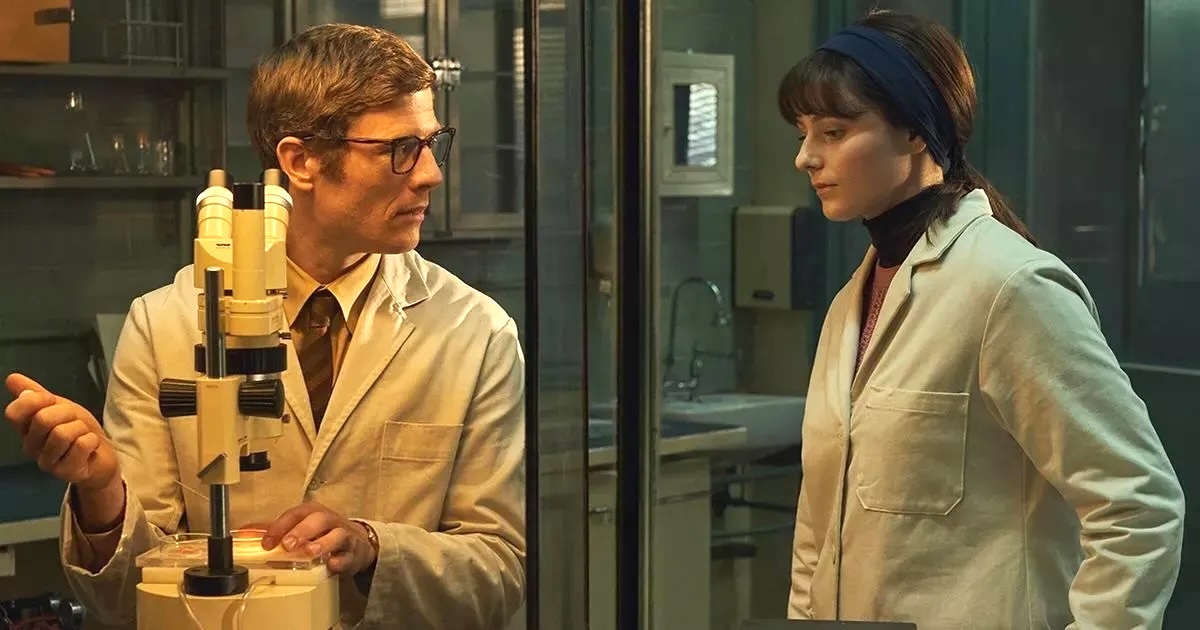
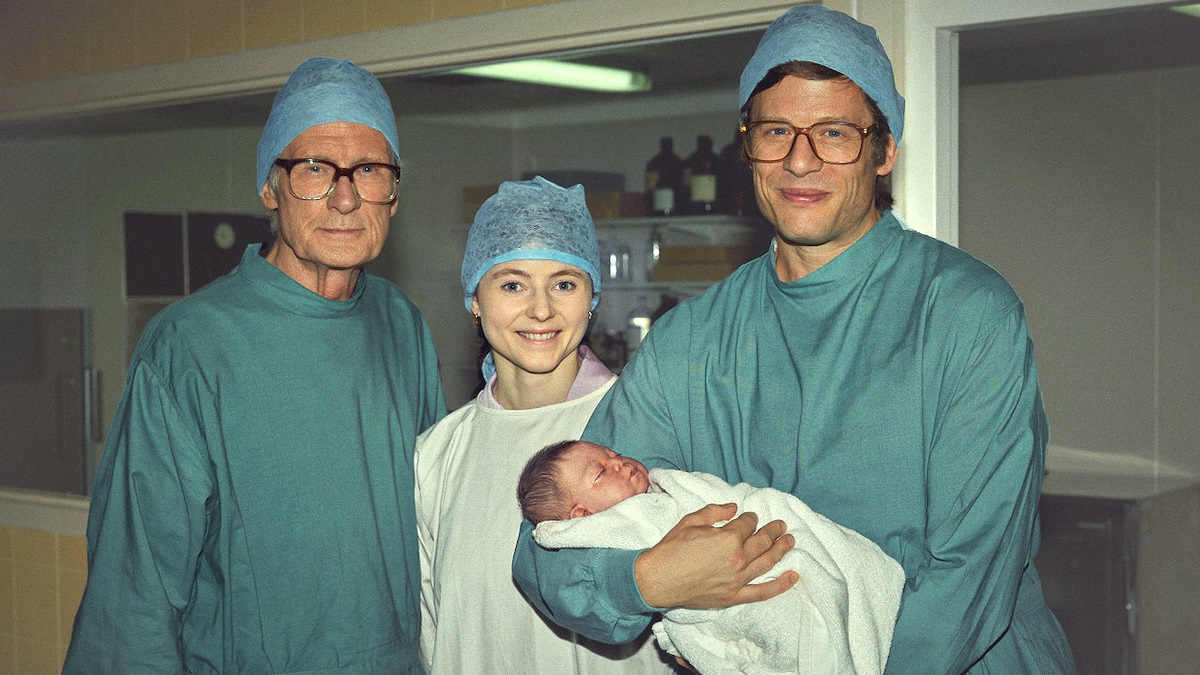
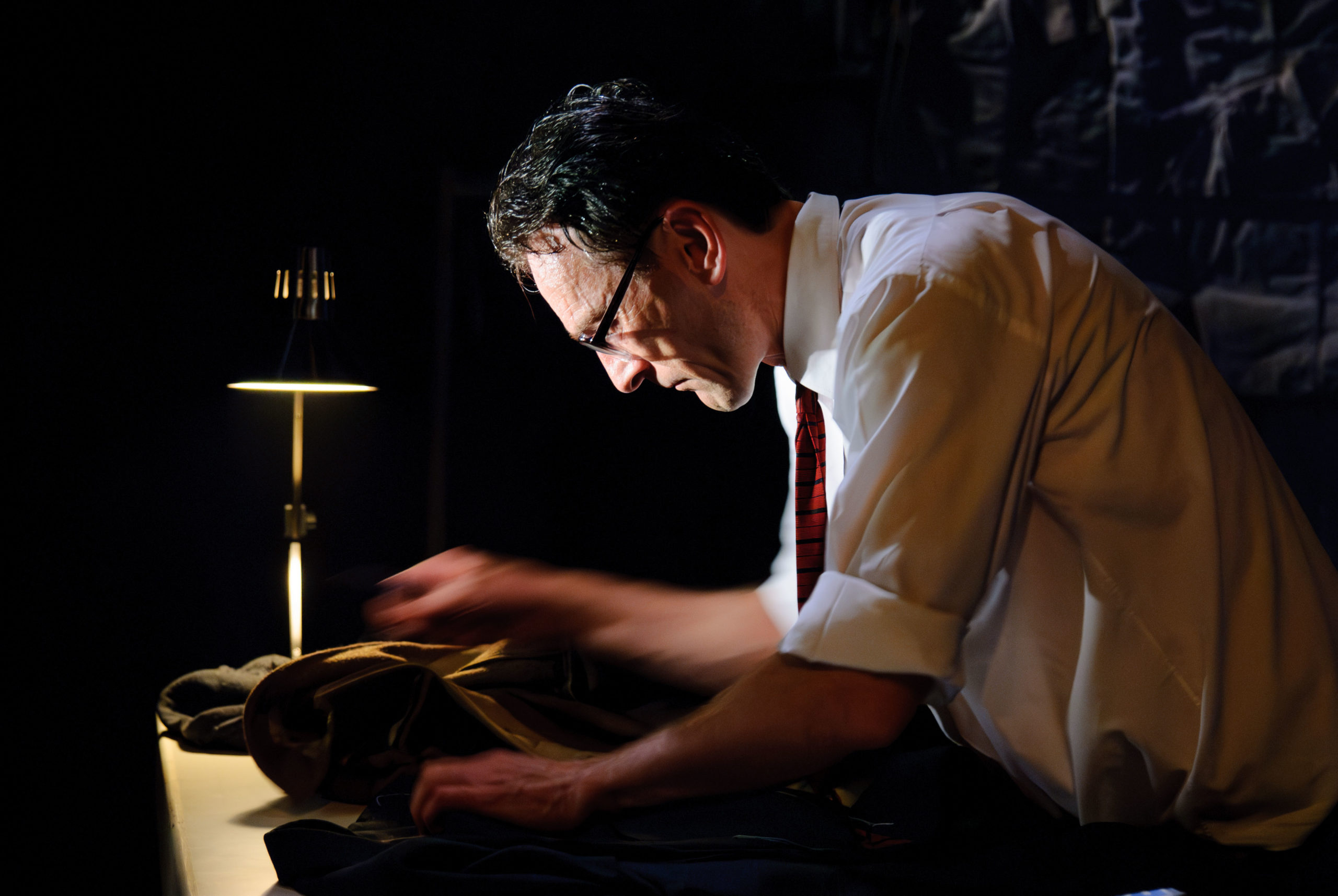
This story begins in 1965 when we meet Purdy (Thomasin McKenzie), freshly graduated from nursing school, being interviewed by Edwards (James Norton), who has recently embarked on the project that will occupy him for many years. His aim is simple: to provide an answer to all those would-be parents who have been prevented from having children because of a simple quirk of nature. Edwards and Purdy quickly become a duo. But their first goal is to enlist the help of Steptoe (Bill Nighy), who – though brusque and dismissive at first – is soon won over, largely by Purdy’s direct, no-nonsense approach.

The trio duly embark on years of experimentation as they work towards their ultimate goal. Underfunded and mocked by the tabloid press (who dub Edwards ‘Doctor Frankenstein’), it’s a long hard road – and it’s not until 1978 that their years of work finally bear fruit. Along the way, Jean’s relationship with her own mother is broken. Gladys (Joanna Scanlon) is deeply religious and sees this whole endeavour as ‘sinful’ and ‘unnatural.’ She cuts her daughter out of her life and even asks her not to attend the church they have both gone to for years. It’s only when Gladys falls ill that an uneasy alliance is finally established.

Purdy also nurtures a secret: she herself suffers from endometriosis and is unable to have the child that she has always longed for…

Jack Thorne’s screenplay is beautifully understated, as is Ben Taylor’s direction, which effortlessly catches the drab look and feel of the 60s and 70s. The three leads handle their roles with considerable aplomb and McKenzie in particular is wonderfully affecting, managing to convey her character’s inner turmoil with little more than a wistful look and a sidelong glance. As somebody who has personal experience of the benefits of IVF in the form of my much-loved daughter (and I fully appreciate how easy it was for me as the male in the relationship), I don’t mind admitting that some of the scenes here have me filling up.

Joy is a ‘small’ film, which probably accounts for the fact that it’s not competing with the likes of Gladiator 2 at your local multiplex and, instead, has gone straight to streaming. But it’s really worth the watch. It tells a fascinating true story of courage and determination.

And in its own quiet way, it’s a remarkable film.

4.3 stars

Philip Caveney
Wicked: Part One

22/11/24

Cineworld, Edinburgh

It’s gratifying to see the cinema so busy on this icy cold November evening. There’s been a lot of speculation recently about movie-goers being averse to musicals – indeed, there was a notable absence of songs in the trailer for this very film. But, if tonight’s showing is anything to go by, there’s plenty of life in the genre yet. Just not, perhaps, when it strays into the DC universe (Joker: Folie a Deux, I’m looking at you).

Oddly, considering how often I’m at the theatre, I’ve never actually seen Wicked on stage, so the movie is my introduction to the tale. This is clearly not the case for most of the audience: there’s an abundance of green clothing and nail varnish, a lot of excited pre-film chatter and groups of women in the loos afterwards discussing where the film diverges from the show they know and love. Thankfully for the industry, the reactions I overhear are universally positive.

For me, there are a couple of negatives. First, I’m not super-happy about the fact that this is just ‘Part One’. I always feel cheated by movies that only tell me half a story and, although the central relationship between Elphaba and Galinda has a satisfying arc, the dark hinterland – the genocidal capture and destruction of speaking animals – is barely developed at all. Second, with the exception of Defying Gravity, none of the songs seems particularly memorable.

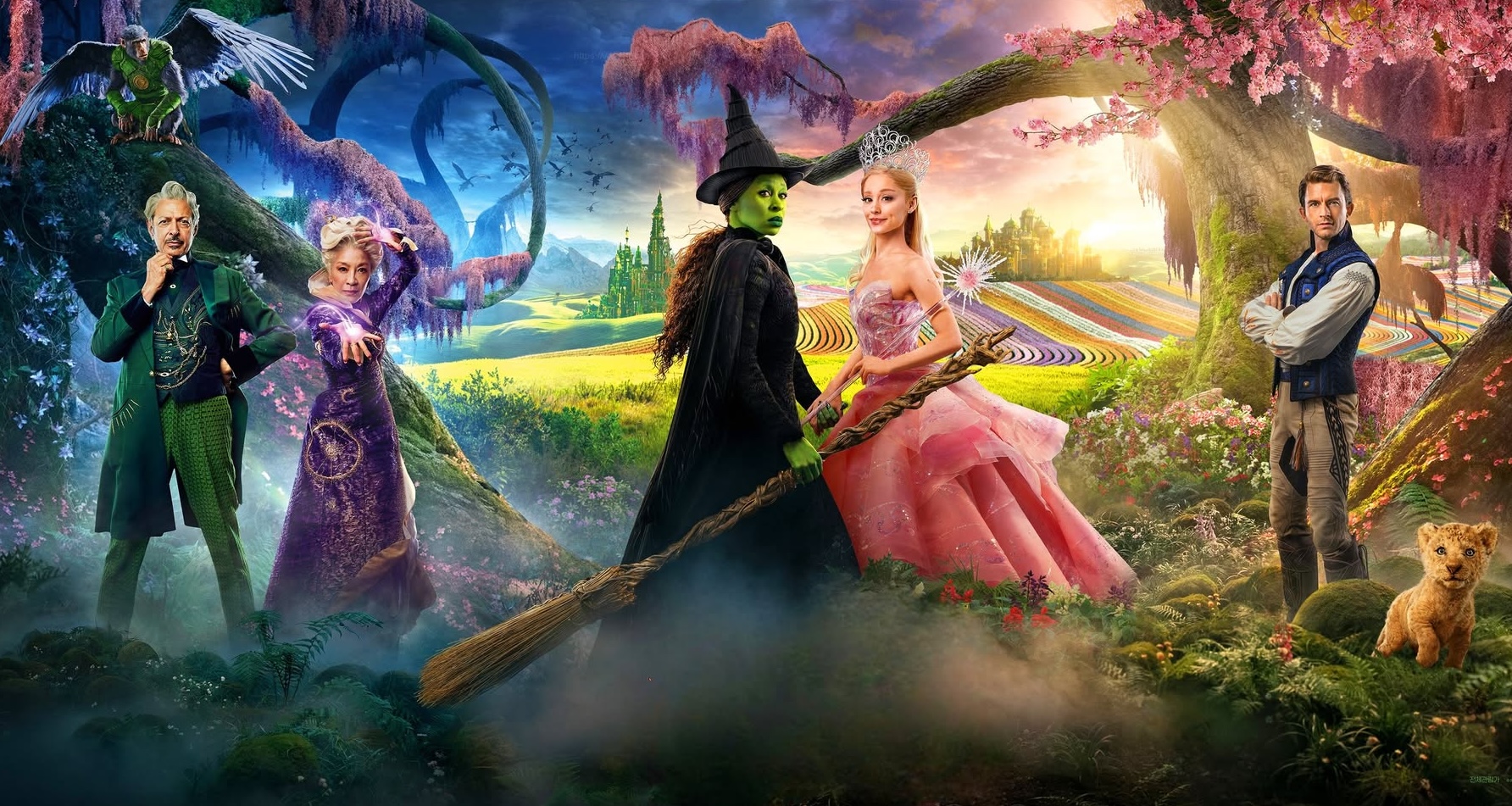
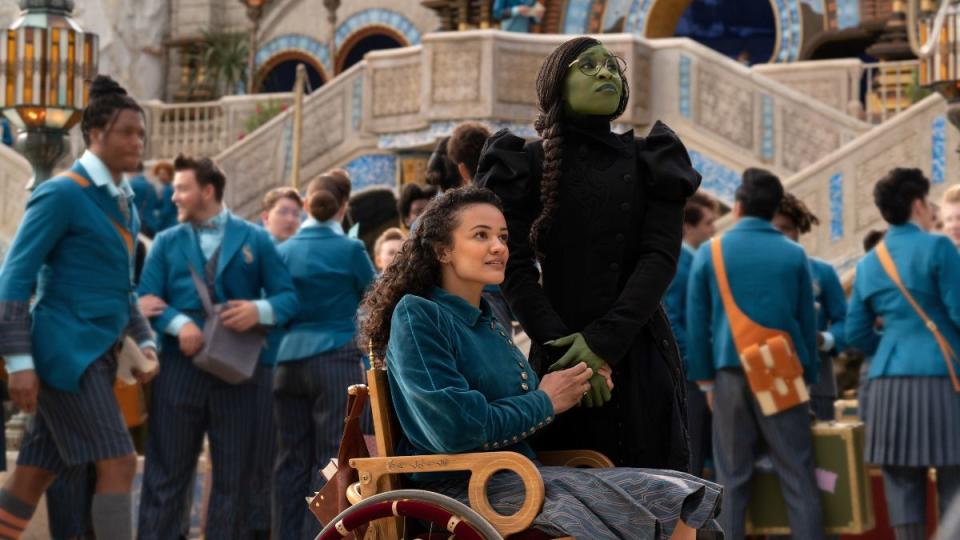
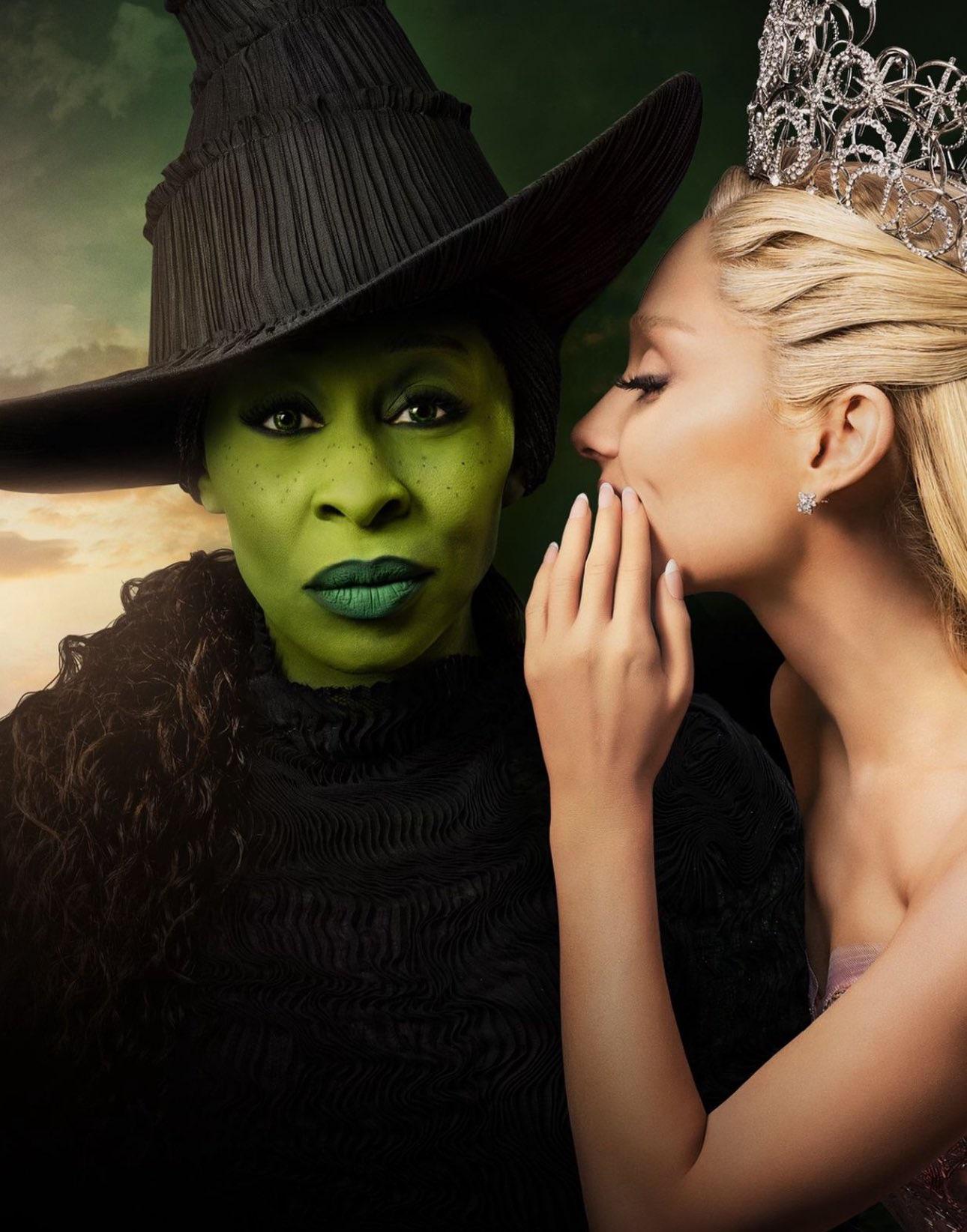
For the most part, though, Wicked is great. For those not in the know, it’s the origins story of the opposing magical forces of good and evil from The Wonderful Wizard of Oz, i.e. The Wicked Witch of the West and Glinda, the Good Witch of the North. In this prequel to L Frank Baum’s novel, Elphaba (Cynthia Erivo) and Galinda (Ariana Grande) meet at boarding school, where they are forced to share a room. Initially, they despise one another: Elphaba is powerful, studious and green, while Galinda is rich, popular and, well… blonde. But opposites attract, and over time they learn to see the good in one another, forging a strong friendship – which even survives the strain of their attraction to the same guy, Fiyero (Jonathan Bailey). When their history professor, a goat called Dr Dillamond (Peter Dinklage), is arrested and forcibly removed from their classroom amid nefarious plans to cage all speaking animals, Elphaba’s sorcery teacher, Madame Morrible (Sandra Yeoh), encourages her to go to the Emerald City, to plead with the Wonderful Wizard (Jeff Goldblum). But all is not as it seems…

Erivo and Grande are perfectly cast as the mis-matched pair, both utterly captivating in their roles. While Erivo provides the emotional depth – Elphaba is a study in suppressed yearning – Grande is the comic relief, all fluffy self-absorption and steely sweetness. It’s a delightful pairing.

Thanks to Alice Brooks’ cinematography, the film looks sumptuous. Oz has been gloriously rendered by designer Nathan Crowley: it’s a little bit steam-punk, a little bit Middle Earth, a truly fantastical land. I love the repeated cog motif, in Shiz academy’s library, on the Oz train and – naturally – in the Emerald City’s Royal Palace. Director Jon M Chu has created a superb stage-screen hybrid, combining established musical theatre-style choreography with a very modern filmic sensibility. LGBTQ+ themes are brought to the fore, with many explicitly queer-coded characters, and lots of deliberate ambiguity, so that we – along with the Ozians involved – are made to ponder where the line is drawn between platonic and sexual attraction, between friendship and love. It works well, emphasising the teenage protagonists’ heightened emotions. No wonder young adults love this story so much.

Judging by tonight’s screening, Wicked: Part One looks certain to be a box office success. I just wish I didn’t have to wait a year for Part Two.

4.1 stars

Susan Singfield

,

Gladiator 2

17/11/24

Cineworld, Edinburgh

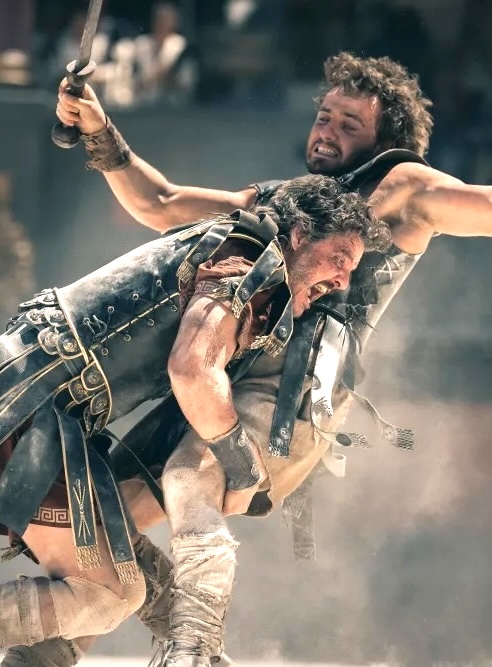
Back in the year 2000, Gladiator was a significant game-changer. Ridley Scott’s sword and sandal epic, starring a lean, mean Russell Crowe, wowed audiences and critics alike. It was nominated for twelve Oscars and actually won five, including Best Picture and Best Actor for Crowe. Over the intervening years, Scott has often stated his intention of doing a sequel, if only he could find the right story. And finally, nearly twenty-five years later, I’m sitting in front of an IMAX screen, eager to see what he’s come up with.

I seriously doubt that Gladiator 2 will be picking up any awards (except perhaps for special  effects) because I suspect that galley has sailed. And to be honest, in most respects it plays more like a re-run of the original than an honest-to-goodness sequel. But don’t let that put you off.

It’s some thirty years after the death of Maximus when we first meet Lucius (Paul Mescal), a soldier living and working in Numidia, alongside his wife, Arishat (Yuval Gonen.) But it isn’t long before a huge fleet of Roman warships, led by General Marcus Acasius  (Pedro Pascal), appears on the horizon. As ever the Romans are looking to extend their empire and this is just the next step in their bid for world domination. An epic battle ensues, replete with giant trebuchets and fusillades of arrows. In the carnage, Arishat is killed and Lucius taken prisoner and ferried back to Rome. On the long sea voyage he (understandably) nurtures a desire for revenge on Acasius. 

Rome is no longer the glorious empire it once was. Ruled by despotic brothers, Geta (Joseph Quinn) and Caracalla (Fred Hechinger), it’s become a place where corruption holds sway and where cunning players like gladiator-master, Macrinus (Denzel Washington), can rise to positions of influence. Does the latter have bigger ambitions than buying and selling gladiators? Well, naturally he does.

Macrinus quickly spots a quality in Lucius that he feels he can exploit and gets him into the arena at the earliest opportunity. Lucius, it turns out, has the ability to pulverise all who oppose him, even if he does pause every so often to quote Virgil. Could it be that he has some connection to the late Maximus? When we learn that Acasius’s wife is Lucilla (Connie Nielsen – the only major character to return from the original film), it soon becomes clear where this story is headed…

Gladiator 2 could justifiably be criticised for failing to explore new ideas, but this film’s DNA is all about its sheer sense of scale. Scott has always been a master of battle scenes, and lovers of spectacle can hardly complain about being short-changed in that department. Deep into his eighties now, Scott is a director who knows how to capture massive action set-pieces at testosterone-fuelled levels that are rarely even attempted these days. Wherever possible, he utilises real sets and thousands of extras in order to convey their magnitude.

There are some call-backs to the first film – scenes featuring wheat, whole lines of dialogue lifted from Gladiator 1 and that trope of stooping down to pick up a handful of earth, as though such actions can be inherited. And screenwriter David Scarpa even throws in a cheeky ‘I am Spartacus’ moment, which I think is fair enough under the circumstances. A suitably beefed-up Mescal effortlessly places a sandal-clad foot onto the A list while Washington is clearly having a whole ton of fun, camping it up as a devious player, who will seemingly let nothing get in the way of his rise to power.

There are a couple of missteps. An early dust-up in the Colosseum has Lucius and his fellow-captives pitched against a tribe of what appear to be shaved baboons, CGI creations that seem to have wandered in from some kind of demented science-fiction movie – and quite how the skinny, blonde-haired kid from the flashbacks has grown up to be Paul Mescal is one for the geneticists of the world to figure out.

But if the aim of this film was to go bigger and louder than what came before (and I suspect that was exactly the object of the exercise) then it has succeeded in spades. The sequence where a pitched sea battle is enacted in the flooded coliseum is an extraordinary slice of action cinema (and, before you Google it. let me assure you such things did actually happen – though the addition of sharks might be a touch of artistic license). Likewise, Scarpa’s cast of characters is, for the most part, loosely based around real historical figures.

I know I say this a lot but don’t wait for streaming. See this on the biggest screen available and, as you watch, ask yourself that all important question:

“Am I not entertained?” For me, the answer is, most definitely a resounding, “Yes, I am entertained!”

4.5 stars

Philip Caveney
Men Don’t Talk

17/11/24

Scottish Storytelling Centre, Edinburgh

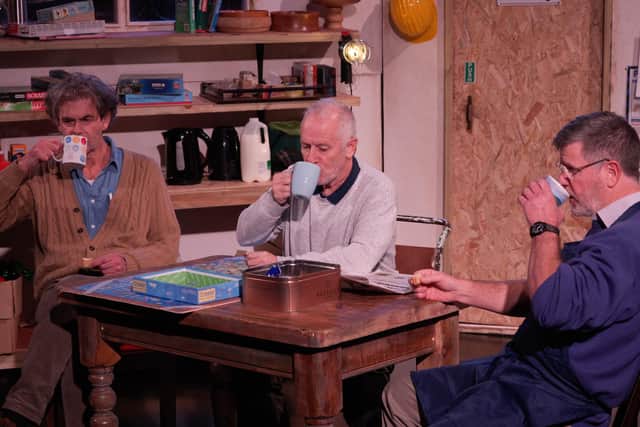
“You’ve not been here before, have you?” asks Ken (Dougal Lee), addressing a member of the audience who has ostensibly turned up at the Men’s Shed for the first time. “How do you take your tea?”

“Er, just milk,” says the man in Row 2.

The shed boasts two kettles, Ken tells us proudly, switching one on and putting tea bags into a couple of mugs. While he waits for the water to boil, he chats amiably about why he’s been coming to the Men’s Shed ever since he retired. He needs a bit of space away from his wife, he says. They’ve never been under each other’s feet before. The shed is a place where he can come to enjoy the company of other men. And build a bat box.

He pours water into the mugs, adds milk, squeezes the tea bags and pops them into a food waste bin. Then he hands the mug over to the man behind me. “There you go.”

Writer-director Clare Prenton’s script has an endearingly gentle tone. The atmosphere in the shed is relaxed and understated; it’s easy to see why it appeals to the men who visit it. Based on extensive interviews with real-life Men’s Shed members, Prenton shines a light on the importance of creating spaces where men can talk.

Because they don’t, apparently. Unless they’re shoulder to shoulder, that is, rather than face to face. Men’s Sheds provide opportunities to learn new skills and there’s no pressure on the members to open up about their feelings. But, working alongside one another, helping out with art or craft or DIY projects, it turns out that men begin to feel comfortable sharing their personal stories. And that they are more than willing to put an arm around a pal’s shoulder and support them if they can.

This matters, because men’s mental health is in crisis. Suicide rates are worryingly high. The good news is that change is happening: we no longer tell our children that boys don’t cry; we don’t encourage repression or a stiff upper lip. And Men’s Sheds can play an pivotal part in this shift, especially for older guys.

As well as Ken, we also meet Jimmy (Billy Mack), an alcoholic who needs somewhere to be that isn’t the pub, and Tom (Greg Powrie), a widower who’s taken up woodwork since his wife’s demise. Through these characters and their meandering conversations – which cover PTSD, grief and custard creams -Prenton presents a convincing case, even when dealing with the controversial issue of whether women should be allowed to join. Ken’s the outlier who says no, while the others – including forty offstage members – have all voted yes. No one agrees with Ken but it’s to Prenton’s credit that his impassioned argument isn’t ridiculed, and he isn’t reduced to a clichéd misogynist for expressing this desire.

Today’s performance is BSL interpreted, and I’m impressed by how well the interpreter is incorporated into the action. He’s a named member of the Men’s Shed, greeted as Greg, drinking tea and eating biscuits with the rest of them, nodding hello and then translating what they say. It’s neatly done.

I also love the fact that the detailed, naturalistic set, designed by Frances Collier, has been built by Peebles & DIstrict Men’s Shed. This adds to the feeling that this is a truly inclusive piece, and that Prenton has treated her subject with the respect and gravitas it deserves. It’s a didactic play, but – although I definitely feel that I have learned something – I never feel lectured. And, if I were a man in need of a chat or a new project or simply somewhere convivial to be, I’d certainly be checking to see if there was a Men’s Shed in my locale.

4 stars

Susan SIngfield

Pygmalion

15/11/24

Bedlam Theatre, Edinburgh

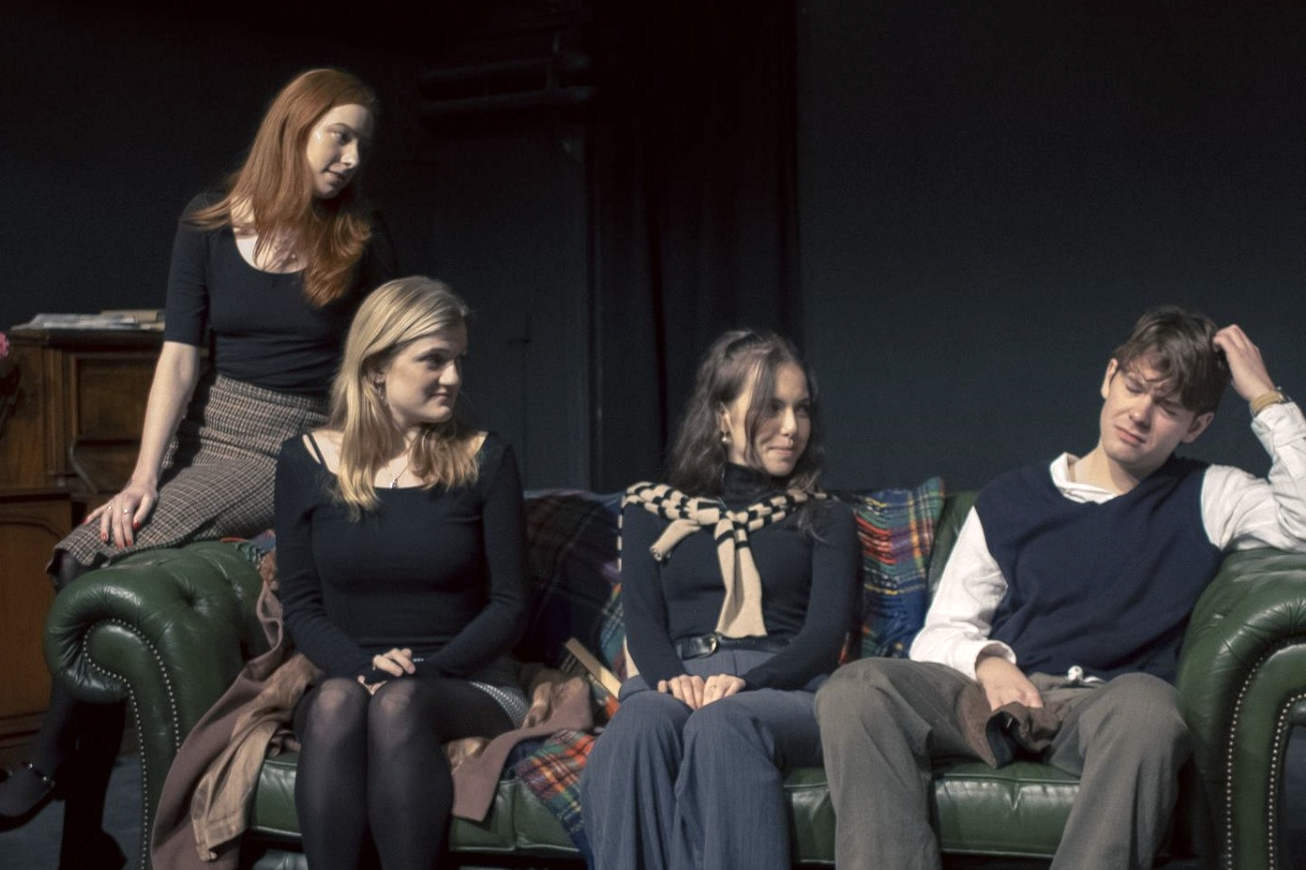
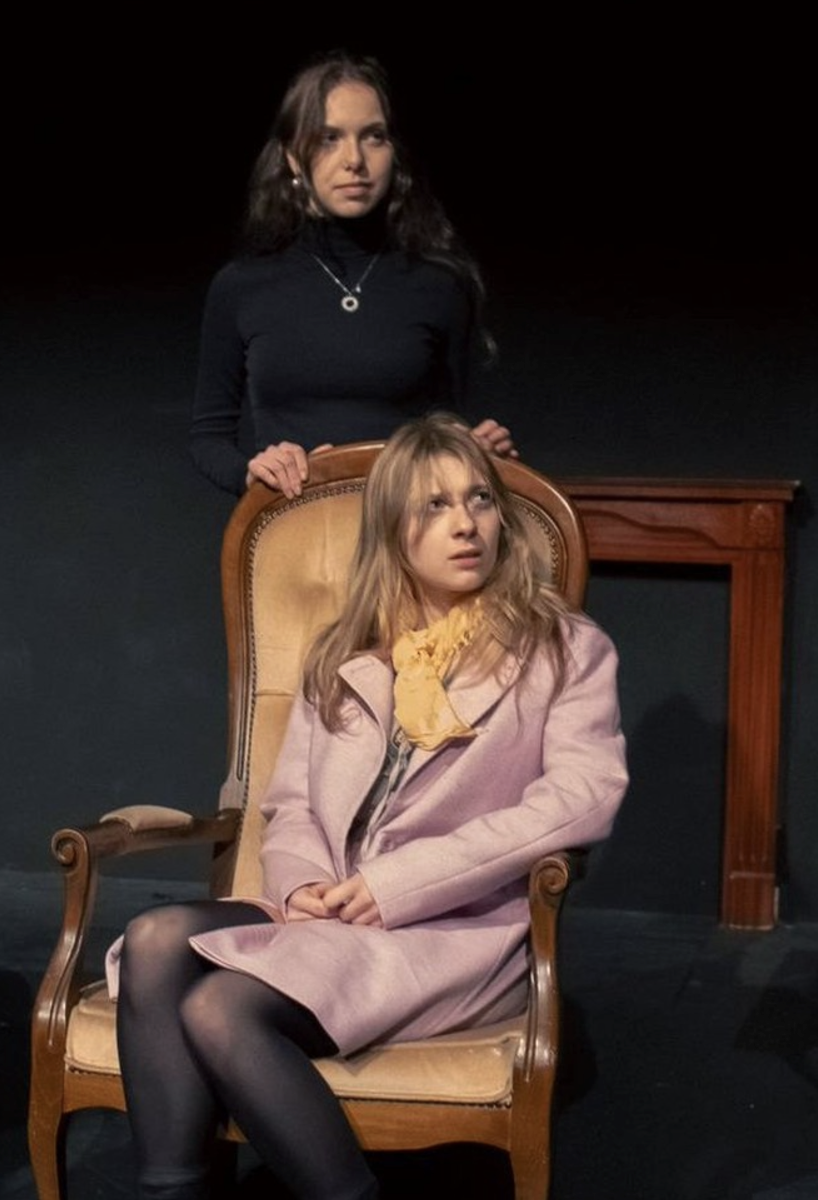
We last saw Pygmalion in 2010 at Manchester’s Royal Exchange Theatre, with Cush Jumbo and Simon Robson as the central duo. Fourteen years later, we’re at Bedlam, keen to see what EUTC will do with George Bernard Shaw’s famous tale of transcending social boundaries. The promo material promises an interesting modernisation, as working-class biology student, Eliza, fresh from Belfast, comes into the orbit of English trust fund baby, Henry, at Edinburgh university.

Directors Shira David and Victoria Ge do a good job of illuminating the play’s humour, the acerbic dialogue and pratfalls eliciting belly laughs from the audience. However, the updated premise doesn’t quite work for me. In the original version, Eliza is in real need and Henry’s tuition offers her a way out of her poverty. What’s more, in 1913, when the play was set, accents were directly linked to opportunity: if Eliza Doolittle could learn to speak like a lady, a different world would open up to her. I find myself struggling to see what’s in it for this Eliza. It’s asking a lot of an audience to accept that a student at a prestigious university is “in the gutter” just because she has an Irish accent – she sounds the same as my GP and local pharmacist, as film stars and TV presenters. We need to see more of her struggle to believe in it. An evening job selling flowers isn’t such a hardship, after all. Nor is it clear why this young Henry Higgins – himself a student – wants to take on the project. This isn’t helped by the scene transitions: long blackouts cover minimal scenery changes, slowing down the action and pulling us out of Eliza and Henry’s world, making it harder for us to suspend our disbelief.

Costume-wise, the coding needs to be clearer. Eliza has an expensive-looking hair cut and brand new Dr Marten’s at the beginning but keeps on her ripped tights even when she’s been re-styled. It also comes as a shock at the end of the play when Eliza says that Henry is too old for her, because that hasn’t been signalled prior to this moment.

Despite these misgivings, it’s an enjoyable production. Connie Bailie has all the requisite charm for Eliza and Frankie Reid is suitably churlish as Henry. George Laing’s Pickering is perhaps the most convincingly-drawn character – disinterested and affable, outwardly pleasant but ultimately untouched by Eliza’s plight. Michael Healey provides comic relief as the hapless Freddy Eynsford-Hill, while Lisa Gillham, Aislinn McSharry and Mia Cresswell-Melstrøm work well as a trio of posh young women, supportive of Eliza and rolling their eyes at their pal Henry’s all-too-familiar nonsense.

In the end, this is a laudable idea that doesn’t quite come off – but I remain impressed by EUTC’s drive and ambition. After all, “What is life but a series of inspired follies?”

3 stars

Susan Singfield

The Tailor of Inverness

14/11/24

Traverse Theatre, Edinburgh

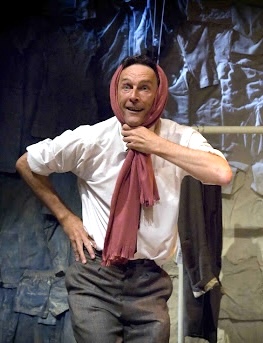
 Matthew Zajac’s remarkable monologue tells the true story of his father, Matteusz, born in Poland and destined to be inextricably caught up in the turbulent happenings of the Second World War, despatched first to fight for his home country and then, latterly, enlisted by both the German and the Russian armies. But when we first meet Matteusz, he’s telling his young son a popular folk tale about a boy and his father, pursued through the snow by a pack of wolves. Zajac speaks initially in Polish, the translated words projected onto a backdrop that is itself a collage of countless garments, plastered onto a wall. As Zajac talks, fiddle player Gavin Marwick provides an inventive accompaniment and the musician remains onstage throughout, his playing reflecting the varying moods.

Zajac soon switches to English, speaking in his father’s voice (with a delightful Polish/Scottish accent), telling us of his early days in Glasgow: how he first became a tailor and how he eventually ended up in the more tranquil environs of Inverness. It’s warm, amusing stuff, but it’s evident as he talks that there’s more – much more – that he is not ready to reveal right now. It’s only as the story progresses that the various threads are unravelled and the hard truths emerge. When Hitler’s forces invade Poland, Matteusz’s life is irrevocably disrupted and, in the desperate struggle to survive, this man’s ultimate loyalty can only be to himself.

Of course, real life has none of the convenience of fiction and sometimes Matteusz’s story is so complex, so labyrinthine, it’s hard for me to get a fix on exactly what’s happening. Maps are projected onto the backdrop to illustrate Matteusz’s travels during the years of conflict – from Poland to Russia, from Galicia to Africa. A series of different uniforms are pressed into service to depict his switching loyalties. Well, not loyalties exactly, but which particular army he is next forced to enlist in.

Zajac is an accomplished storyteller and he manages to hold a packed audience spellbound as, in the later sections of the narrative, he switches from being his father to being himself, as he sets out on a mission to unravel the parts of Matteusz’s life that have been kept hidden – and to track down the sibling that Matthew didn’t even know existed. 

It’s an extraordinary tale and it’s weirdly unsettling to hear Zajac talking about the butchery going on between Russians and Ukrainians back down the years, only to reflect how essentially nothing has changed. The Tailor of Inverness is by no means a perfect piece of theatre – I feel sure that solving the issues of those more bewildering sections is not beyond the efforts of a playwright – but perhaps the play’s continuing success points to the old adage of not fixing what isn’t broken. 

And there’s little doubting the exuberant applause which Zajac receives as he takes his final bow.

3.7 stars

Philip Caveney
The Brenda Line

13/11/24

Traverse Theatre, Edinburgh

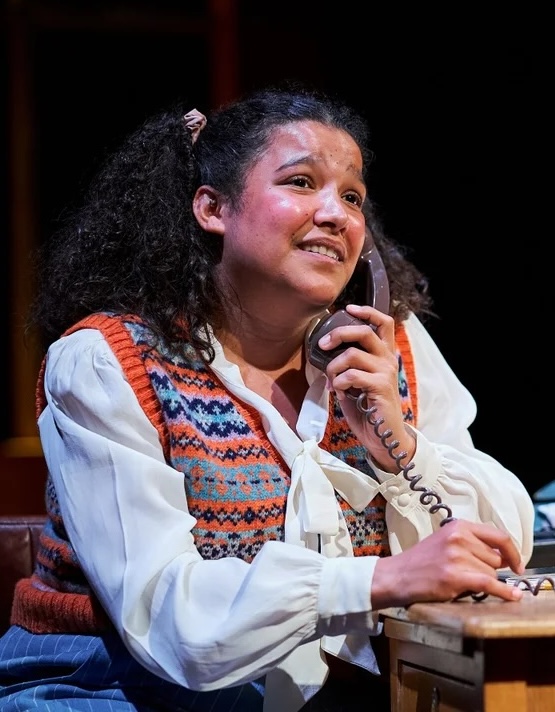
Harry Mould’s debut play is an exploration of a little-known aspect of the Samaritans’ work. Until today, I hadn’t even considered that there might be any need for ethical debate around the simple kindness of providing a ‘listening ear’, offering comfort to the desperate, company to the lonely, a glimmer of hope to the suicidal. But – through their own mother’s experiences – Mould has uncovered something weirdly problematic in the organisation’s past: the eponymous ‘Brendas’, designated volunteers, who (between 1958 and 1987) consented to hear out those men who called seeking sexual gratification, wanting someone to talk to while they masturbated. Anglican vicar Edward “Chad” Varah founded the Samaritans on the principle that it should be a non-judgemental organisation, turning no-one away. But of course, these particular callers pose a moral conundrum, rife with contention.

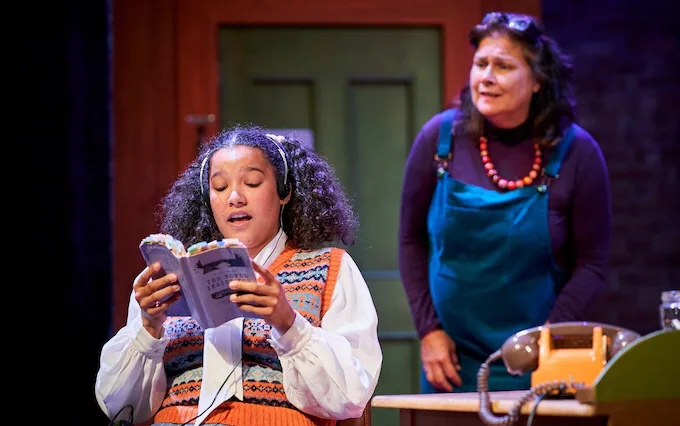
Mould positions the issue as a debate between two chalk-and-cheese volunteers. Anne (Fiona Bruce) is an old-hand with a pragmatic approach to the work she does. She’s warm but gruff, confident but self-effacing, and perfectly comfortable listening to her “befriendable regulars” talking about the knickers they imagine she’s wearing or telling her about their erections. Karen (Charlotte Grayson) is only eighteen, and she’s Anne’s polar opposite: an engaging, opinionated character whose lively charm belies her brittle reserve. She’s innocent, prudish and very defensive about her lack of life experience – and she certainly isn’t going to hold back from telling Anne exactly what she’s doing wrong. In response, Anne smiles, shrugs and offers to make tea.

It’s a winning formula and, directed by Ben Occhipinti, the actors infuse their characters with disarming likability. This makes sense; they’re good people, giving up their time to try to help others, spurred on by the urge to make a difference in a troubled world. Mould’s dialogue is very well-written, and I especially enjoy the allusions to the women’s backstories, rendering them convincingly real: Anne’s unrequited love for her former colleague, Gracie; Karen’s inability to make friends and her struggle to deal with the prejudice she encounters as a mixed-race woman.

The detailed, naturalistic set, designed by Natalie Fern, clearly evokes that particular ilk of workplace claustrophobia, where everything outside seems oddly unreal and diminished, in this case heightened by the blacked out windows and emphatically locked door.

However, while Karen’s argument is well-defined, Mould seems on shakier ground with the older woman’s reasoning – we never hear a lucid explanation as to why Anne accepts her role as a Brenda. She has had many years to consider her position, so it seems logical that she would be able to put forward a compelling defence. Instead, she’s strangely reticent. Nonetheless, by the end, Karen seems to have accepted Anne’s line of thinking, which I find a little confusing. I don’t know what Anne has said to change Karen’s mind.

Despite the subject matter, the writing is also a little coy: although Karen refers to the inherent power dynamic between the male caller and the female listener, there’s no deeper consideration of what this means – of how Anne might derive a sense of power herself from these calls, for example, or even feel somehow that she deserves the degradation. What drives the men to call these anonymous women and is it okay for “Chad” – the leader – to ask his workers to comply? I can’t help feeling that there is more to be explored here.

Nonetheless, Mould has created two engaging, memorable protagonists and, through them, they have shed light on a fascinating piece of recent history.

And now it’s time for me to call my mum and tell her what I’ve learned tonight about her name…

3 stars

Susan Singfield

Paddington in Peru

11/11/24

Cineworld, Edinburgh

After the success of Paddingtons 1 and 2, it was perhaps inevitable that a third instalment would eventually amble into view. But previous director Paul King did set a high bar. His films were perfect family-friendly adventures that kept both children and adults thoroughly entertained. King has now transferred his talents to the somewhat under-appreciated Wonka franchise, so this time out, directorial duties fall to Dougal Wilson, while the screenplay is the work of four writers, one of whom is original scribe Simon Farnaby.

As the title suggests, the third film sees Paddington and his adoptive family, the Browns, leaving their London home in search of Paddington’s beloved Aunt Lucy (voiced by Imelda Staunton), who has gone missing from her nun-run retirement village, deep in the jungles of Peru. The alarm has been raised by the Reverend Mother (Olivia Colman, in yet another scene-stealing role). It’s apparent pretty much from the outset that there’s something a bit dodgy about her – though she’s still unmistakably, adorably, Olivia Colman, singing and dancing her socks off. Once in Peru, the Browns – Hugh Bonneville, Emily Mortimer (replacing Sally Hawkins), Madeleine Harris and Samuel Joslin, accompanied as before by Mrs Bird (Julie Walters) – fall in with mysterious riverboat captain, Hunter Cabot (Antonio Banderas) and his daughter, Gina (Carla Tous). Cabot is introduced via an obscure film reference (Werner Herzog’s 1982 jungle odyssey, Fitzcarraldo), that only a few movie buffs are likely to spot.

A convoluted South American adventure dutifully ensues with occasional nods to Indiana Jones and the like, but it must be said that this isn’t quite as sure-footed as the previous offerings. Paddington (Ben Whishaw) is still utterly delightful and just as prone to pratfalls, but the slapstick isn’t as assured and the ‘fish-out-of -water’ premise of the first film doesn’t really work so well in a jungle. Furthermore, with just about every actor that has appeared in the series popping up for an obligatory cameo, plus scenes where Cabot is haunted by no fewer than five of his gold-obsessed ancestors, the film feels too busy and over-stuffed for its own good. There’s also a tendency for the film’s messages to be pounded home with a huge mallet rather than trusting younger audiences to take them on board.

Don’t get me wrong, Paddington in Peru has enough endearing moments to make it worth the watch and I’m sure youngsters will still be suitably entertained by the little bear’s antics but, all things considered, this offering comes in a good distance behind its predecessors.

Make sure you stay in your seats through the lengthy credits for a welcome call-back to (yet another) character from one of the earlier movies. Sadly, although I’m happy to see him, this only serves to emphasise that the latest adventure doesn’t offer anyone else quite as memorable.

3.8 stars

Philip Caveney