Month: January 2015

The Theory of Everything

MV5BMTAwMTU4MDA3NDNeQTJeQWpwZ15BbWU4MDk4NTMxNTIx._V1_SX214_AL_

6/1/15

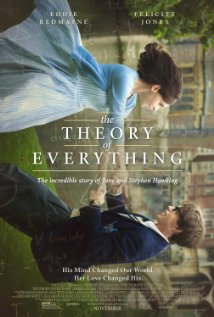
After the tragic tale of Alan Turing as portrayed by Benedict Cumberbatch in The Imitation Game, prepare to be totally devastated by the almost equally tragic tale of Professor Stephen Hawking. Even if this story has a more uplifting conclusion, (Hawking winds up as a National hero rather than being chemically castrated) there’s still plenty to weep over along the way so be prepared and take along a good supply of tissues.

Based on the book my Hawking’s ex-wife, Jane, the story begins in 1963, where a vigorous young Stephen (Eddie Redmayne) is studying his craft at Cambridge University. The period detail is quite nicely captured, though this is a 1960s where (apparently) nobody smokes a cigarette and where a firework display looks decidedly better than the dismal pyrotechnics I remember from my own youth. But these are minor niggles. After a chance meeting at a pub, Stephen connects with Jane (a radiant Felicity Jones) and after a little uncertainty, they become lovers. But tragedy waits in the wings when after a fall, Stephen is diagnosed with motor neurone disease and told that he has two years to live. Cue the tears.

The remainder of the story is how the couple triumphed against all odds, managing to become parents three times over and how Stephen came to write the most successful book that nobody actually read. It’s also essentially about how Jane sacrificed so much in order to be Stephen’s full time carer. If you were worried that it would be all hearts and flowers, don’t despair, because there’s a fairly sour conclusion to this real life tale that’ll get the old tear ducts flowing all over again. A host of solid performers struggle to make themselves visible in minor roles (poor Emily Watson barely gets a look in) but this film belongs entirely to its lead actors. Redmayne is frankly astonishing, managing to inhabit Hawking’s tricky persona with ease and never losing sight of the man’s innate dignity, but it’s Jones who is the real revelation here, portraying Jane as a woman determinedly maintaining her English Rose composure whilst clearly displaying every inner torment through those soulful eyes. It’s surely a performance worthy of Mr Oscar when the time comes around.

The Theory of Everything is more than just another tearjerker. It’s stylishly done and comes complete with two superb performances fitted as standard. Just don’t forget to take that box of Kleenex!

4.6 stars

Philip Caveney
Annie

MV5BMTAyNDYxOTI4MzNeQTJeQWpwZ15BbWU4MDQ3MDU3NjIx._V1_SX214_AL_

4/1/15

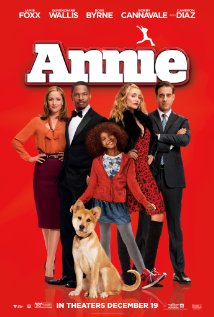
Will Gluck’s reworking of Annie is a curate’s egg of a movie. The screening we attended what not so much peopled by ‘little girls’ whose freckles needed stamping on, as by women my age, who had clearly been fans of the 1982 version – and if they were anything like me – had high hopes this might have more verve and sparkle than the anodyne 1999 Disney adaptation. It certainly does have more verve and spark. In the lead role, Quvenzhané Wallis (an absolute delight in Beasts of the Southern Wild) is as feisty, kooky and determined as she needs to be and, she’s charming too, so that her disarming of Jamie Foxx (the restyled Daddy Warbucks) is quite credibly portrayed. The modernisation is nicely handled also. Foxx plays Will Stacks, a self-made mobile phone entrepreneur in need of a better media image; his cribs-style apartment is pure property porn. Rose Byrne as his PA, Grace Farrell, is perfectly adequate and it’s good to see Annie’s friendship with the (accidentally) racistly-drawn character of ‘mystic’ Punjab ousted in favour of a more sympathetic relationship with Warbucks’ chauffeur, Nash (Adawale Akkinuoye-Agbaje.)

But there are some unfortunate mis-steps too. Cameron Diaz’s Miss Hannigan really doesn’t work. She’s unconvincing as a foster mother of any sort, lurching and gurning her way drunkenly around the children’s home, clearly playing at trashy rather than living it. The music’s a bit hit-and-miss too. There are some interesting re-arrangements of the the old songs and a few new numbers thrown in to good effect, but they all lack lung-power and musicality; surely every musical needs at least one big blousy number? In 1982 Annie had some to spare. Here, they have been summarily kicked out and this is a mistake I think. Likewise the half-hearted choreography. Back in the day everyone hoofed it up in great style but here the actors stumble apologetically around as though they don’t quite want to admit they’re actually in a musical.

Overall, I liked it. Sort of. But I don’t see it capturing the imaginations of today’s kids in the way that Aileen Quinn and Carole Burnett did in the 80’s. This version simply isn’t strong enough to compete with everything that has gone before.

3.1 stars

Susan Singfield

Birdman

MV5BODAzNDMxMzAxOV5BMl5BanBnXkFtZTgwMDMxMjA4MjE@._V1_SX214_AL_

1/1/15

The first film of the New Year turns out to be this quirky and offbeat offering from Alejandro Gonzalez Inaritu, a riveting slice of cinema that’s actually all about live theatre and the essential differences between the two media. It’s heartening to see a packed screening on opening night for what is essentially a highly experimental work, one that has as many questions as it does answers and one moreover that is cleverly edited to look like one continuous tracking shot.

Riggan Thomson (Michael Keaton) is undergoing a long dark night of the soul. Formally the star of a series of successful superhero movies, he is attempting to rejuvenate his career by appearing on Broadway in an adaptation of a Raymond Carver short story which he has written himself. When his lead actor is injured the night before the first performance, he manages to acquire the services of Mike Shiner (Ed Norton) a conceited method actor who is as destructive as he is accomplished. Meanwhile Riggan juggles the affections of his daughter cum personal assistant, Sam (Emma Stone), his lover Laura (Andrea Riseborough) his lead actress Lesley (Naomi Watts) and his manager, Jake (an unusually retrained Zach Galifiniakis.) But the spectre of his previous screen persona still haunts him and he is having terrible trouble differentiating between what is real and what is imaginary…

The film is never less than captivating and from time to time takes off on inspired flights of fantasy that dazzle the eye and stir the imagination. Keaton is a revelation in the lead role, giving the audience insights into the mind of a man who is constantly on the edge of insanity (his previous incarnation as Tim Burton’s Batman gives the story added poignancy) and the script comes laced with a vein of dark humour that never shrinks from savaging the very industry that has nurtured it. If the other films of 2015 are in this league it’s going to be a fine year indeed.

4.8 stars

Philip Caveney

Exodus: Gods and Kings

MV5BMjI3MDY0NjkxNl5BMl5BanBnXkFtZTgwNTM3NTA0MzE@._V1_SX214_AL_

30/12/14

Ridley Scott is perhaps the closest thing we have to a director of the stature of David Lean. Unabashedly old school he is never happier than when commanding armies of extras on a massive scale, so perhaps it was inevitable that he would eventually take on a biblical subject – the story of Moses. Here, the great man is played by a scowling Christian Bale who at the beginning of the film is fighting the Hitites alongside his ‘bessie mate’ Ramses (Joel Edgerton.) But when Ramses becomes pharaoh, word gets out that Moses is actually an adopted hebrew, a fact that gets him banished from Egypt and sent back to join ‘his people’ where before very long he is instructing them to seek their freedom.

There has already been some controversy about this film which features two caucasian actors in the lead roles and Scott’s reply (that it was all about getting funding and who would pay to see Mohammed Whatever in the lead role?) was understandably badly received, but I’m going to put that matter aside and concentrate on what’s on the screen, which really is a great big curate’s egg of a film. This being a Ridley Scott production, there are scenes of incredible cinematic splendour – the construction of the pyramids is amazing, the Plagues of Egypt are particularly jaw-dropping and the climactic parting of the waves is nail-biting stuff – but along the way we have to endure too many turgid scenes of people standing around in temples talking in (suspiciously contemporary terms) about fairly boring subjects. And one has to wonder why Scott bothered to engage the services of Sigourney Weaver when he wasn’t going to bother to give her anything to say. What I did like was the daring treatment of many of the accepted fantastical elements of Moses’ story. The parting of the waves is quite clearly a tsunami, we see Moses himself carving the ten commandments onto stone tablets and most contentious of all, ‘God’ is depicted as a scruffy kid with a bad haircut. Some will hate this, but what was the alternative? A white haired, bearded old geezer speaking in a stentorian voice? A bit too Life of Brian, methinks.

in the end, Scott does it his way and God help anyone who stands in his path. Overall, I enjoyed this, but those slow lengthy passages dragged down the final score somewhat. One thing is clear. When it comes to epic cinema, nobody else comes close to the majesty that is Ridley Scott. On a sad note, the film is dedicated to his brother, Tony, who took his own life in 2012.

3.8 stars

Philip Caveney

Big Eyes

MV5BMjA2ODM5MDE3N15BMl5BanBnXkFtZTgwOTIxNjc1MzE@._V1_SX214_AL_

30/12/14

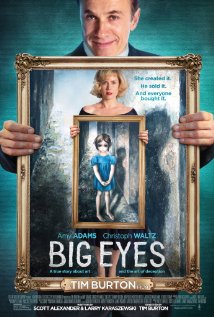
Tim Burton’s latest offering eschews the weird and wonderful fantasy for which he is best known and concentrates instead on a ‘so weird it has to be true’ tale about bad art and flawed people. In many ways, this is Burton’s best work since Ed Wood, with which it shares some DNA – scriptwriter Scott Alexander worked on both movies.

The film opens in the late 1950’s and Burton has skilfully evoked the era in his own exaggerated, slightly surreal way. Amateur painter, Margaret (Amy Adams) has just run out on her husband, taking her young daughter Jane along with her for the ride. She finds work and in her spare time tries to sell her paintings, a series of (rather dodgy) portraits of big-eyed children. She soon encounters Walter Keane (Christophe Waltz) another wannabe artist and the two of them hit it off. Within weeks they are married. When Keane’s flair for publicity starts to kindle interest in Margaret’s art, he persuades her to let the world believe that he is actually their creator and to release them under the signature of ‘Keane.’ She reluctantly goes along with it. But neither of them have realised quite how successful Margaret’s paintings will become. As the millions begin to roll in, Margaret finds herself increasingly tortured by the deceit that they have created; and the desire to be recognised as an artist. When the marriage starts to founder, it’s clear that one way or another, the truth will have to come out.

This is an intimate, small scale story that gets to the heart of the thorny subject of intellectual property. Adams and Waltz are both superb in their roles (Waltz has some particularly funny scenes, particularly in the courtroom drama at the film’s conclusion) and Burton is always better, I think, when his creative juices are reined in and he works with somebody else’s script. (Like many critics, I feel he’s lost his way lately – Alice In Wonderland was a particular disappointment, even though it racked up huge receipts at the box office.) Big Eyes however, is an excellent film and one that stands with his best work.

4.4 stars

Philip Caveney

One Chance

MV5BMTA5MzQxMzEzOTVeQTJeQWpwZ15BbWU4MDY2NzM5NzIx._V1_SX214_AL_

24/12/14

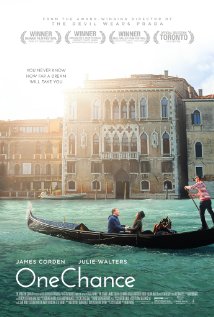
Biopics are a notoriously difficult medium in which to score a cinematic hit, especially when the subject of said biopic is not particularly famous. Paul Potts’ singular claim to fame is that he was the winner of the very first series of Britain’s Got Talent. Since then, he’s remained pretty much out of the public eye, though by all accounts, he’s doing quite well for himself.

This film follows Paul (James Corden) through his episodes of childhood bullying, his inability to please his steelworker father (Colm Meany), his more sympathetic relationship with his mother (a criminally underused Julie Walters) his days as a salesman at Carphone Warehouse and his on-off romance with Julz (the ever-delightful Alexandra Roach.) Matters come to a head when, on a self-financed opera-course in Venice, despite showing considerable promise, his nerves eventually get the better of him when asked to perform for his hero, Pavarotti. There are also a couple on incidents of incredible bad luck which seem solely designed to put him off pursuing opera-singing as a career. Corden does a good job of making us care about Potts (indeed, it’s hard to understand why such large numbers of the general public reserve levels of contempt for this actor that would seem more suited to a fascist dictator.) While One Chance is hardly world-shattering stuff, it’s nonetheless an enjoyable slice of entertainment that actually managed to make me listen to the words of Simon Cowell without breaking out in hives.

The film died at the box office and it’s easy to see why – after all, who was it aimed at? Too trivial for opera-lovers, too serious for fans of BGT, too obscure for those who enjoy a good biopic. But nonetheless, this makes for decent family viewing on DVD.

3.8 stars

Philip Caveney

3.9 stars

Philip Caveney