Month: October 2014

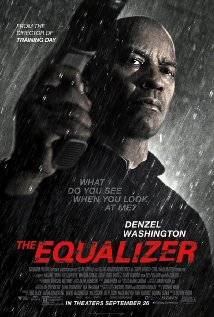
The Equalizer

MV5BMTQ2MzE2NTk0NF5BMl5BanBnXkFtZTgwOTM3NTk1MjE@._V1_SY317_CR0,0,214,317_AL_

05/10/14

Older readers may have fond memories of a TV series featuring Edward Woodward as McCall, a retired MI6 operative who operates as an avenging angel for hire by anyone who finds themselves oppressed by villains. This film shares the basic plot and the character’s surname but, after that, all similarities end. Denzel Washington plays the American McCall, a quiet, seemingly mild-mannered chap who likes nothing more than a good book and a cup of herbal tea. He works at his local DIY superstore and often enjoys late night chats with a young call girl, Teri (Chloe Grace Moretz), who is employed by a gang of Russian mafiosi. When Teri gets beaten up by them, McCall swings smoothly into action, unleashing a maelstrom of bone-crunching violence and we begin to realise that he’s not quite as mild-mannered as we might have thought. The plot thickens (and the body count rises) when top Russian hit man, Teddy (Martin Csokas looking like Kevin Spacey’s evil twin) arrives from mother Russia to take care of business.

Director Atoine Fuqua has directed Washington before, notably to Oscar glory in Training Day, but trust me, this film isn’t going to win any Oscars. It’s something of a mixed bag. Early action sequences are stylishly handled and Washington exudes a gravitas that carries much of the rather lightweight material, but the extended climactic shootout may as well have been titled 101 Ways To Die In B & Q, as Denzel unleashes every power tool in the shop in order to take out the veritable army of Russian thugs that has come to kill him. And how many times must we watch the same tired trope of the good man avenging the helpless female victim? (Washington has done that better in Man On Fire for Tony Scott.) Having said that, there is a kind of guilty pleasure to be had by watching the action unfold.

It’s a curate’s egg of a film. Good in parts, but more often indigestible.

3.2 stars

Philip Caveney
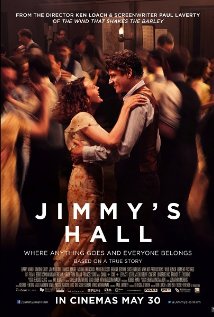
Jimmy’s Hall

MV5BNTk0NDk4MzIzMl5BMl5BanBnXkFtZTgwNjMwMTA5MTE@._V1_SY317_CR11,0,214,317_AL_

04/10/14

A new film by Ken Loach is usually a cause for much celebration, but Jimmy’s Hall falls somewhat short of his own impeccable standards. Of course, he’s done Ireland before (much more successfully) with The Wind That Shakes The Barley, a film so filled with anger that it makes for uncomfortable (though riveting) viewing. With this story, Loach’s longtime screenwriter Paul Laverty, homes in on a much more intimate real life story, set in Co Leitrim in the late 1930’s. Jimmy Gralton (Barry Ward) returns to his hometown after a ten year exile in New York. Back in the day, he  fell foul of the authorities with his ownership of a local dancehall, which was seen by many to be a focus for discord and (God forbid) communism. But he isn’t back home long before the local youth start pestering him to open up the dance hall again, arguing that these are more enlightened times and surely nobody could possibly object.

It doesn’t take long to discover that the times are nothing of the kind. Gralton comes up against his former adversary, Father Sheridan (Jim Norton) an embittered old priest who thinks he sees communists lurking behind every tree and it isn’t long before the dancehall becomes a target of every hardliner in the vicinity. Gralton’s attempts to make the church accept that those who come to his hall are merely looking for entertainment and education, are doomed to failure.

It’s an interesting little story, but there may not have been enough meat here to base an entire film around. All of Loach’s trademark tropes are present and correct – improvised sequences featuring non-professional actors, naturalistic sound and extended crowd scenes, but in this film, the latter only serve to give proceedings a funereal pace and the story rarely generates any real sparks of life. Loach has been quoted as saying that Jimmy’s Hall may be his final movie, but I sincerely hope not. I’d like to see him go out on a stronger note than this.

3 stars

Philip Caveney

What We Did On Our Holiday

MV5BMzY4MDc4NDYyOV5BMl5BanBnXkFtZTgwODgzMTc2MjE@._V1_SX214_AL_

4/10/14

On paper, this looked rather promising. Created by the writing team that brought us Outnumbered, it seemed to belong in that same tried-and-tested arena of harassed parents vs precocious children. Doug (David Tennant) and Abi (Rosamund Pike) are taking their three young kids up to the Scottish Highlands to visit Granddad Gordie (Billy Connolly) to celebrate his birthday, but nothing here is as straightforward as it might appear. Doug and Abi have actually separated after his infidelity with one of his students, while Granddad Gordie isn’t going to be celebrating any more birthdays, as he’s suffering from terminal cancer. So rather than upset him, everyone (kids included) is told to pretend that it’s business as usual.

The film starts well, following the established Outnumbered formula, as the two parents struggle to control their fractious offspring in a variety of picturesque locations on the long drive up to Scotland and there are plenty of laughs, expertly mined. But all too soon they arrive at their destination and we are introduced to Granddad Gordie, who unfortunately turns out to be one of those all-wise creations who wander around spouting lines that would be better placed on a series of novelty fridge magnets. On the morning of the birthday bash (an overly elaborate and expensive affair orchestrated by Doug’s pompous brother, Gavin (Ben Miller) and his depressive wife, Agnes (Amelia Bulmore), Gordie decides to take the three kids on a fishing trip and at this point, the story takes an abrupt left turn into much darker (and it has to be said, faintly unbelievable) territory. The three children take centre stage and matters aren’t helped one jot by the fact that they are considerably less appealing than their TV counterparts – the little girl in particular is profoundly irritating.

Having served up a mostly laughter-free middle section, the writers decide that what we really need to round things off is a syrupy, optimistic conclusion, which they duly deliver complete with a cliff top Highland Fling at sunset. This is a pity, because the film promised so much in its first half hour, that the dismal ending somehow rings even more hollow. Though there are decent performances from most of the adult actors, this can only count as a missed opportunity.

1.8 stars

Philip Caveney

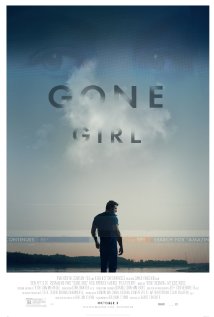
Gone Girl

MV5BMTk0MDQ3MzAzOV5BMl5BanBnXkFtZTgwNzU1NzE3MjE@._V1_SY317_CR0,0,214,317_AL_

4/10/14

David Fincher’s adaptation of Gillian Flynn’s twisted page-turner is a classier affair than the actual book – but as with Before I Go To Sleep, having read the work beforehand is a definite disadvantage, because this is a story that gets its chops from the big reveals it occasionally drops into the proceedings.

On the day of his fifth anniversary, bar owner Nick Dunne (Ben Affleck) comes home to find that his wife, Amy (Rosamund Pike) has gone missing. Signs in the house suggest that she has been abducted. A police investigation ensues and as it unfolds, Nick begins to look more and more suspicious… does he actually know more about Amy’s disappearance than he is letting on? It would be a crime to reveal too much of the plot machinations here because Gone Girl is all about plot. Indeed, Flynn pushes the various twists and turns to such an extent that, in book form at least, the story starts to seem somewhat risible. But Fincher is so adept at creating atmosphere, it’s easier to overlook such shortcomings on the big screen. What’s more he has cast the film so shrewdly, that we believe in characters that on paper seem flimsy.

The book’s conclusion was a particular disappointment for me, but again, Fincher manages to make it work. This is an assured production that never loses momentum and which serves its source material well. If you haven’t already read the novel, maybe you should wait until after you’ve seen the film.

4.2 stars

Philip Caveney