Theatre

Arán & Im

25/10/24

Traverse Theatre, Edinburgh

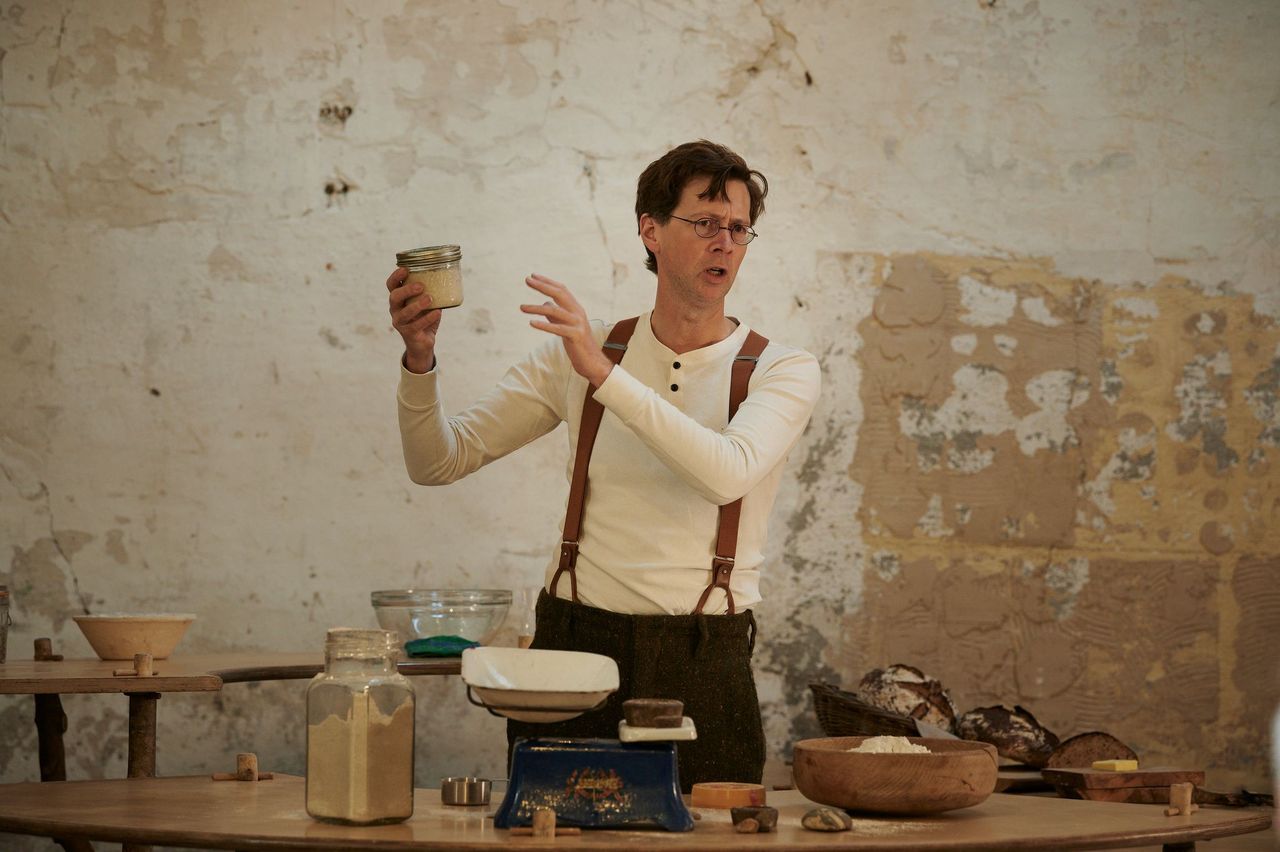
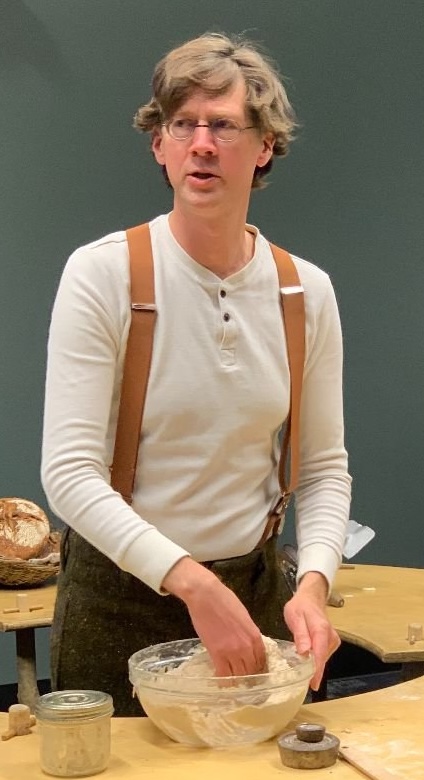
Although the so-called Sapir-Whorf hypothesis – a theory of linguistic relativity, suggesting that the language a person speaks influences how they think about reality – is somewhat out of fashion these days, writer-performer Manchán Magan mounts a convincing argument in its favour. Arán & Im is Irish for bread and butter and it’s the perfect name for this gentle hybrid of a show/lecture. The titular items baked, churned and eaten during the seventy-five minute running time symbolise the words we use: they’re essential, elemental; the basic “bread and butter” of our lives.

About half of the show is in Irish, but you don’t need any prior knowledge of the language to follow what’s happening. Magan is an experienced guide, switching between Irish and English, explaining the myriad meanings behind key words and expressions. He’s clearly fascinated by the way language connects us to our histories and our lands, our mythologies and beliefs. He asks questions of the Scottish Gaelic speakers in the audience (including a whole row of enthusiastic high school students) and delights in the similarities and patterns he observes.

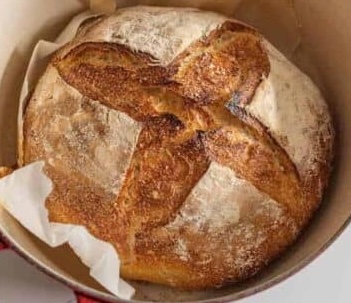
There’s a lot here about not losing sight of our roots, about maintaining our understanding of the fundamental aspects of life – how to make our own bread and butter, if you will. If there’s an issue, it’s that there are so many words. The breaking of bread helps, as does the conversational tone, but there are times when I’d like more visual clues to anchor me: I’d like to be able to read the words being discussed, or to see the constellation maps being described. Admittedly, any obvious tech would be jarring and intrusive: the carefully homespun nature of the piece would come unravelled, so I don’t know what the answer is. But there are moments when I’m overwhelmed by the amount of information and need a different way to absorb it all.

Still, I find the premise fascinating. I grew up in Wales and, although I’m not a Welsh speaker, I’m still steeped in the language. The hymns I know are all in Welsh, because that’s what we sang in primary school. There are certain expressions that always come to me in Welsh before English: dewch i mewn (come in); dwylo i fyny (hands up); ga i fynd i’r toiled os gwelwch yn dda? (can I go to the toilet, please?). This show speaks to me. Language is integral to who we are.

And if nothing else, Arán & Im is surely the most aromatic piece of performance art you’re ever likely to witness.

3.5 stars

Susan Singfield
Detained

22/10/24

Traverse Theatre, Edinburgh

In a week when the Home Office has found the time to issue the fictional Paddington Bear with an official passport, it’s sobering to be faced with a stark reminder of the realities of the UK immigration system and the human lives caught up in it.

Playwright Michelle Chantelle Hopewell’s professional debut has a strong premise, exploring the uneven power dynamic between two friends, where a single impulsive moment of spite has a profound and devastating impact.

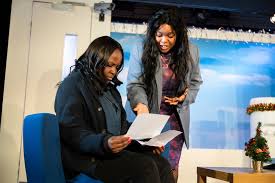
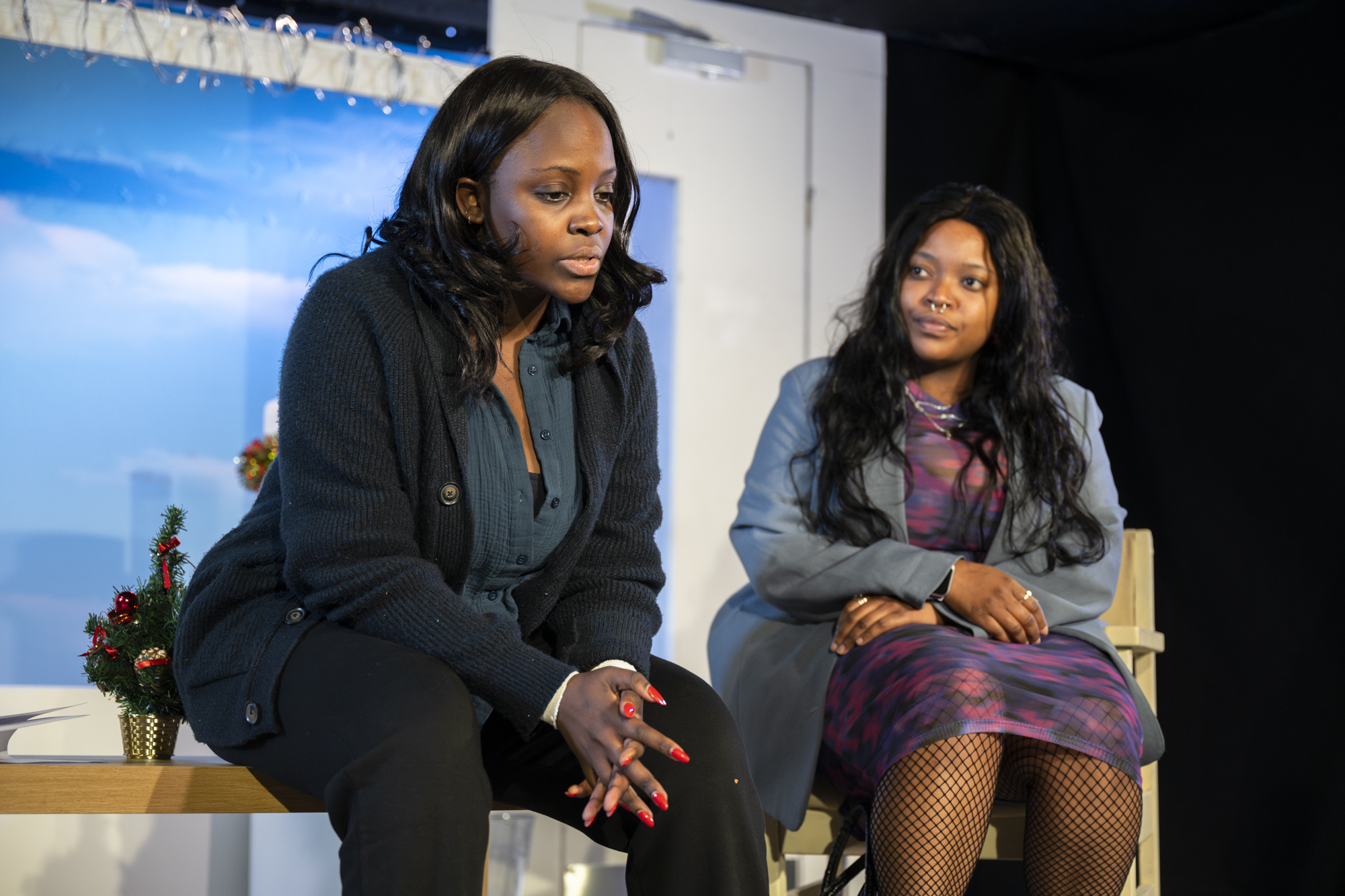
South African asylum seeker Yemi (Titana Muthui) is incarcerated in a detention centre, and she’s appalled to learn that she’s there because of her best friend, Bea (Laura Lovemore). The women work in the same restaurant, and Bea, catching her boyfriend in the arms of another waitress, has called the authorities to report her for being there illegally. She doesn’t know that Yemi’s visa has run out, that her ‘sister’ will get caught in the crossfire.

We’re witness to a series of visits spanning two years, as Yemi languishes in ‘jail’, refusing to open up about her traumatic past, even to the lawyer who might be able to assist her. Through her conversations with Bea, we learn how horribly dehumanising the process is, and how a simple oversight – such as not filling in a form on time – can change a person’s life. Bea is impacted too, learning to live with the guilt of what she’s done, trying – and failing – to compensate by campaigning for Yemi’s release.

Both Muthui and Lovemore are compelling in their roles, with Muthui in particular exuding a desperate dignity. Even though I want to shout at Yemi to tell the lawyer what he needs to know, I can’t help but be impressed by her quiet determination not to be forced to share her nightmares to appease others. Muthui makes this awful choice entirely credible.

Caitlin Skinner’s direction ensures that this wordy drama remains dynamic, and Heather Grace Currie’s simple set design manages to include both the barbed wire holding Yemi back and the blue skies still offering her a glimmer of hope.

Even for A Play, A Pie and A Pint, Detained is short, and doesn’t perhaps make the most of its potential, with a lot of ideas left unexplored. I’m also not convinced by the single section addressed to the audience by Yemi, which feels stylistically (but not tonally) different from the rest. I think for this to work, she would need to be revealing something we haven’t previously seen from her – a greater anger, maybe, or a deeper exploration of her situation.

A piece that asks more questions than it answers, Detained is certainly a play for our times. Let’s hope that fewer pretend bears and more actual people are afforded access to asylum over the coming years.

3 stars

Susan Singfield

Treasure Island

15/10/24

Festival Theatre (Studio), Edinburgh

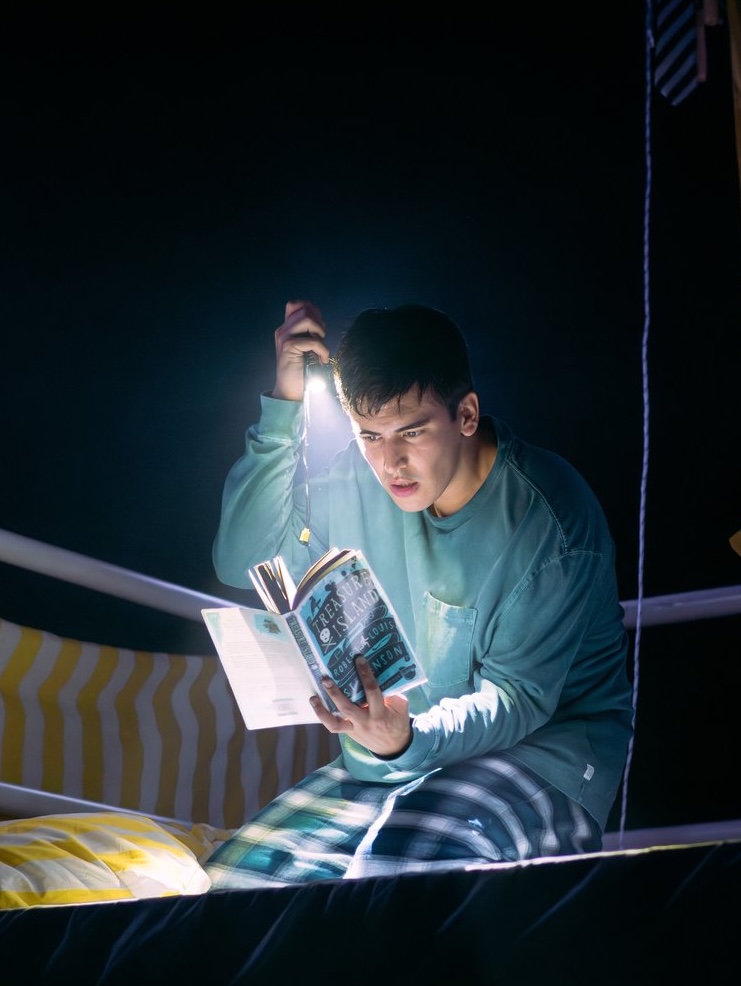
Robbie (Anthony O’Neil) is having some issues at school. He has a good singing voice but, whenever he is required to perform in front of his fellow pupils, he finds himself overcome with anxiety, unable to utter a single word. But Robbie does enjoy reading and, when he picks up a copy of Treasure Island, he finds himself empathising with its young hero, Jim Hawkins – a boy who must conquer all his fears in his quest to find the lost treasure of the mysterious Captain Flint.

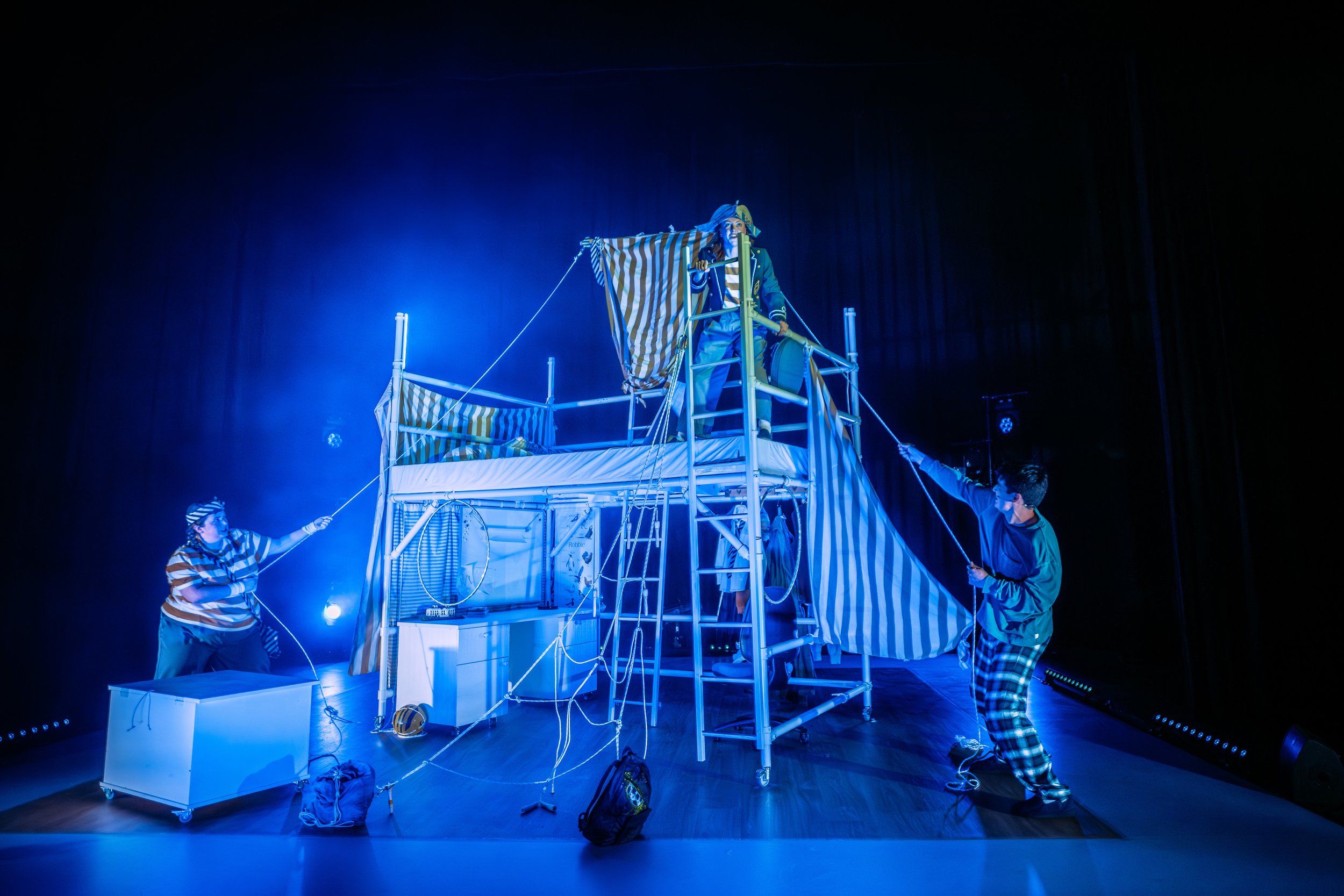
Ross Mackay’s sprightly adaptation of Robert Louis Stevenson’s classic tale is sure-footedly aimed at younger audiences and effortlessly displays the ways in which young readers can escape into their own imaginations. O’Neil stays in the central role throughout, while fellow performers Ali Biggs, Megan McGuire and Simon Donaldson slip smoothly in and out of a whole host of other larger-than-life characters. McGuire shines as a Squire Trelawney with an amusing penchant for malapropisms, Biggs makes a dashing Captain Smollet, while Donaldson delivers just the right amount of threat as Long John Silver. Together the threesome also bash out some stirring songs and jaunty sea shanties, lively enough to have the family audience clapping delightedly along with them.

Becky Minto’s deceptively simple set design allows Robbie’s bunk bed to become a whole series of locations and, with Benny Goodman’s lighting, somehow manages to embody The Hispaniola, tossed on the stormy seas of Robbie’s fevered imagination as well as the Admiral Benbow Inn, set alight by a pack of scurvy sea dogs. The complex adventure is deftly packed into a ninety minute running time and there’s enough happening onstage to ensure that the adults in the audience enjoy the action along with the younger crowd.

Parents looking to introduce their children to a spot of theatre have just two more chances to hop aboard for afternoon shows at the Lemon Tree, Aberdeen and Platform, Easterhouse.

4.2 stars

Philip Caveney

Lost Girls/ At Bus Stops

15/10/24

Traverse Theatre, Edinburgh

Lost Girls/At Bus Stops is my favourite so far in this PPP season: I love the marriage of Róisín Sheridan-Bryson’s fragmented, non-linear writing with Laila Noble’s kinetic direction. 

At its heart there’s a simple will-they/won’t they love story. Ever since Jess (Catriona Faint) approached Iona (Leyla Aycan) at a bus stop with a flyer for a Fringe show several years ago, the two have been friends, meeting up every August to make the most of the Festival buzz, weaving their way from show to bar to show again, navigating the crowds, the hills, the closes, the booze. On the surface, theirs is an easy alliance, born of a shared hedonism and an openness about who they are. Underneath, they’re a mess of repressed longing, each too nervous to risk their precious friendship by declaring how they really feel. And this time, with Iona about to leave for pastures new, there’s an added pressure. If neither of them makes a move, it’ll be too late.

Sheridan-Bryson’s script skips nimbly between dialogue and narration, the protagonists referring to themselves in both third and first person, almost mythologising the city, their accounts of various Edinburgh nights colliding as they disagree about details and bring different moments to the fore. The disrupted timeline mirrors a real-life conversation, almost stream-of-consciousness in its construction, bouncing back and forth through their shared memories.

The two actors portray the contrasting characters with aplomb, Aycan’s gentle stillness a perfect foil for Faint’s more manic, agitated demeanour. As Jess reacts to the pressure by downing drink after drink, snogging random men and trying to start fights, Iona – while matching her on the booze front – is altogether calmer, trying time and again to make Jess stop and talk, to say the things they need to say. Their emotions are palpable and it’s impossible not to feel engaged, not to sit silently urging them to take the plunge. 

Zephyr Liddell’s set is simple but effective, the grimy bus stop and disco lights echoing the superficial glamour of a sequin-clad performer in an archetypal dingy Fringe venue. 

Sheridan-Bryson pulls off the difficult task of creating a play that is at once meta-theatrical and down-to-earth, complex in structure but easy to follow. It’s an impressive piece of work. 

4.6 stars

Susan Singfield

1984

11/10/24

Bedlam Theatre, Edinburgh

George Orwell’s dystopian masterpiece has loomed large over 2024 for us. In April, we listened to Audible’s star-studded ‘immersive’ audio adaptation, where Andrew Garfield, Cynthia Erivo, Tom Hardy and Andrew Scott brought Oceania memorably to life. Immediately afterwards, we both read Sandra Newman’s Julia, a reworking of the novel from the lead female’s point of view. And today we’re here at Bedlam Theatre, ready to see EUTC’s interpretation of the cautionary tale.

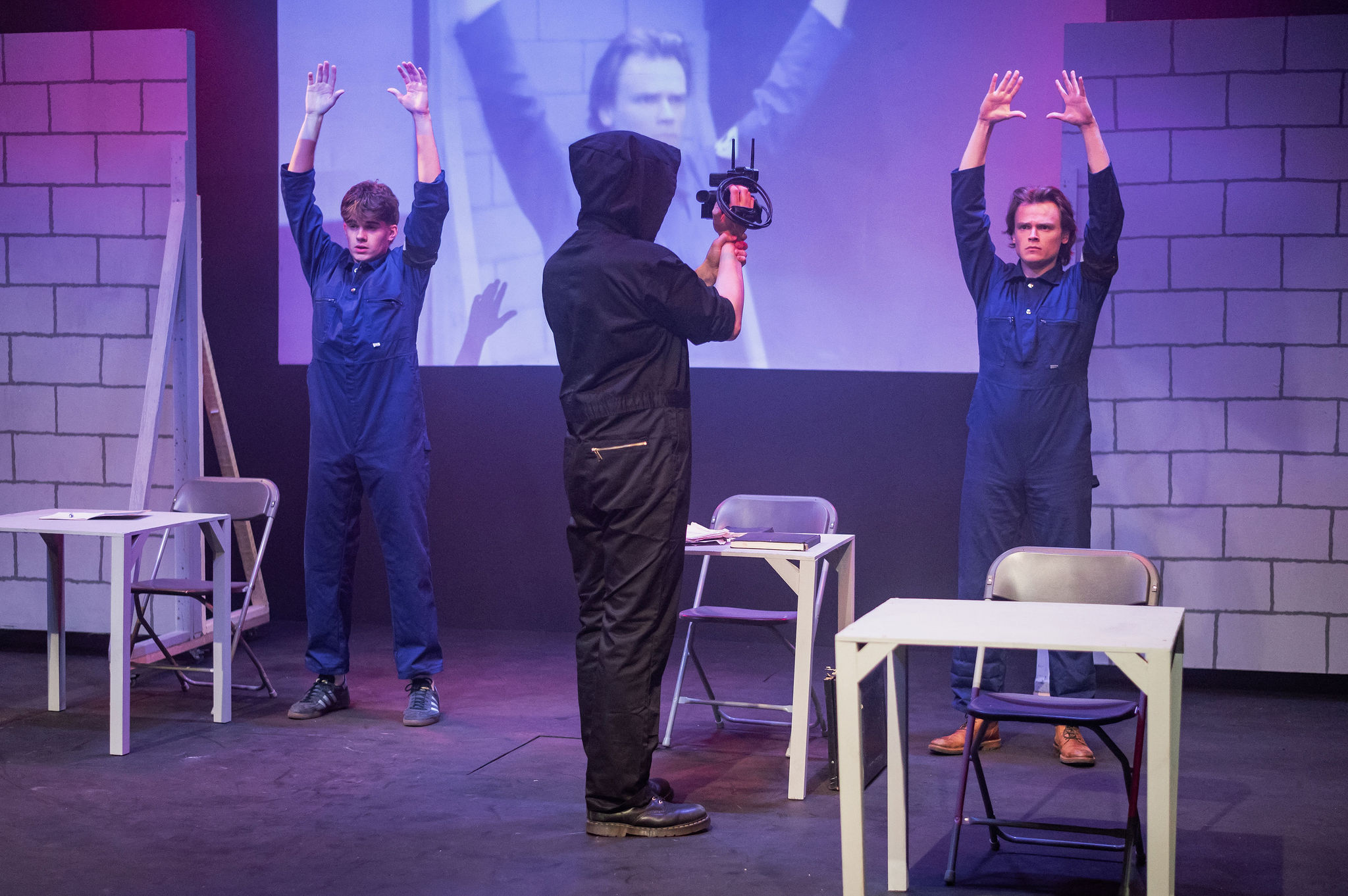
The use of screens projecting both pre-records (Lewis Eggeling) and live video (Tom Beazley) is inspired: there can’t be many stories more suited to a multi-media approach. The scene is set as soon as we enter the theatre: Big Brother (Thaddeus Buttrey) is watching us, a close-shot of his eyes filling the back drop. Instead of ushers, there are guards (Molly Gilbert, Rose Sarafilovic, Dylan Kaeuper and Fergus White), forbidding in their black uniforms, scarfs covering their lower faces. “All hand-held telescreens must be switched off,” one intones; “Silence!” bellows another. Predictably, we all comply.

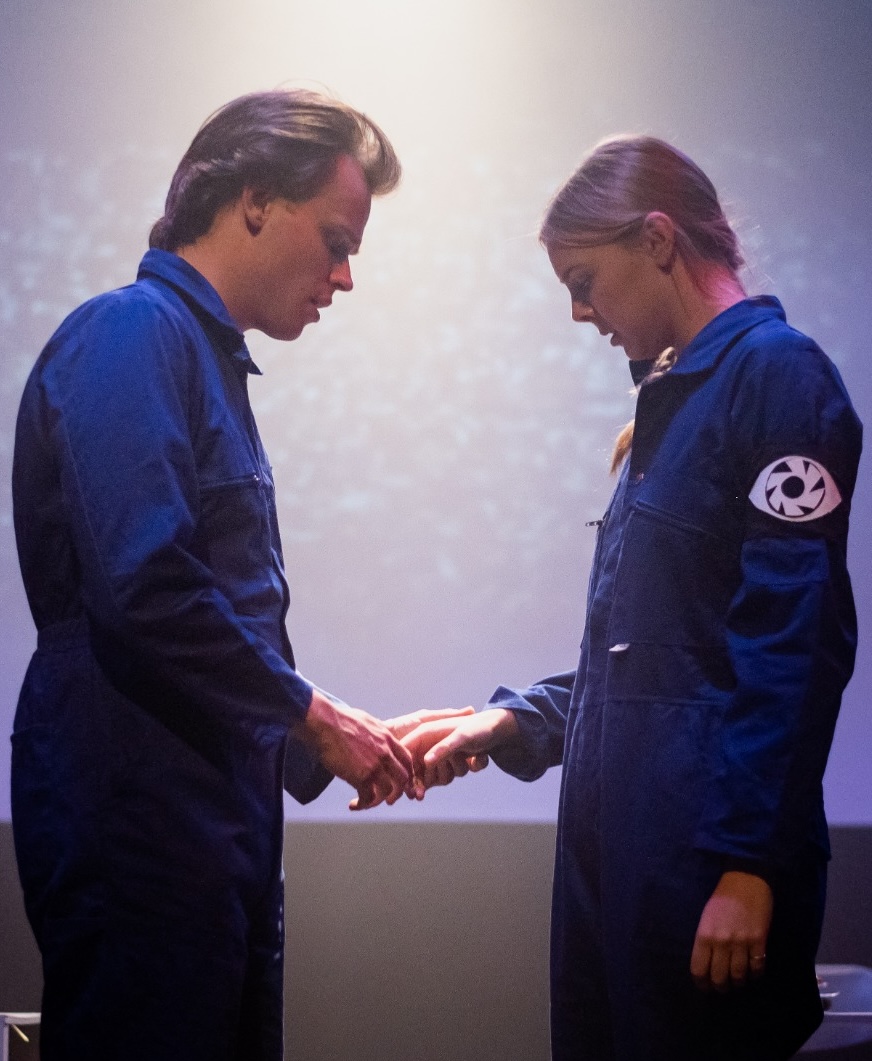
This adaptation (by Robert Owens, Wilton E Hall Jr, and William A Miles Jr) generally works well, plunging us immediately into the middle of the story. What used to be Britain is now part of Oceania, a sprawling dictatorship led by Big Brother, its impoverished citizens ruled with an iron rod by the unforgiving Party. By falling in love, Ministry of Truth workers Winston (Harry Foyle) and Julia (Francesca Carter) have broken the law and, having crossed that line, find themselves increasingly unable to swallow the propaganda they are fed. But what chance do they stand against the all-seeing apparatus of the State?

Director Hunter King does a great job of establishing a sense of threat, as well as highlighting the fragile humanity that endures, despite Big Brother’s best efforts to quash it. “They can make us say things,” as Julia acknowledges, “But they can’t make us think them.” As the central duo, Foyle and Carter both deliver flawless performances: Winston and Julia are convincingly reckless, persuading themselves that they are less vulnerable than they really are, caught up in the excitement of their affair. The story is so well known that there is a dramatic irony not present in the original plot, and King exploits this effectively, so that we find ourselves grieving for the couple even as their relationship blooms.

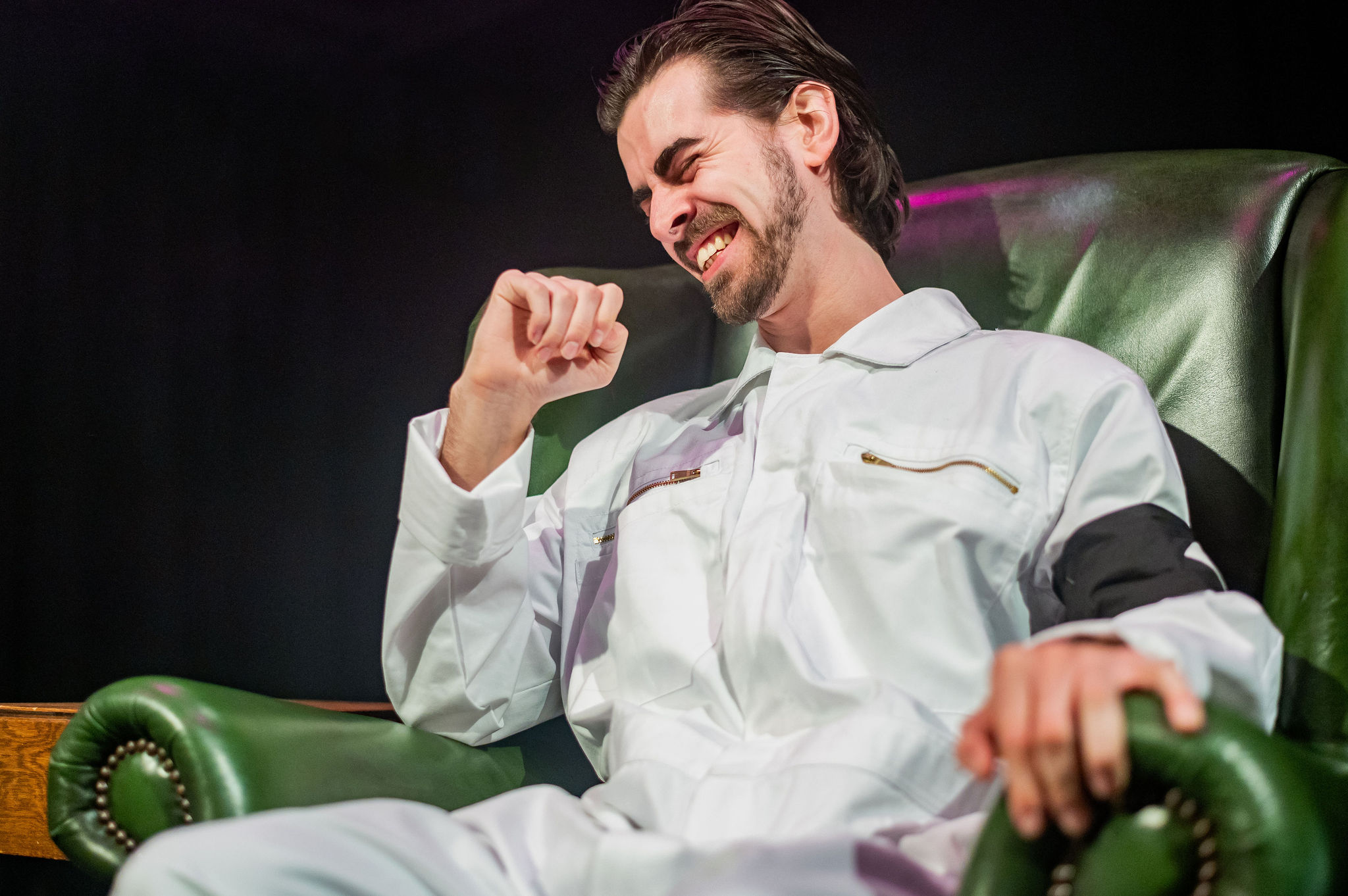
Robbie Morris is clearly having a whale of a time as smarmy backstabber, O’Brien, member of the Inner Party and chief snarer of the unwary. He plays the role as a kind of archetypal villain, complete with maniacal laugh, which makes for an interesting counterpoint, highlighting the freedom that comes with privilege: this is not a man who has ever felt the need to hide or even mute his feelings, unlike even the most loyal Party members. The only other character who seems uncowed is the landlady (Raphaella Hawkins), who owns the apartment Winston and Julia rent for their illicit lovemaking. As a Prole, she has a certain kind of liberty, born of being so poor and lowly that she’s considered unworthy of attention. It’s a dubious advantage.

As we’ve come to expect from Edinburgh University’s student shows, this is an impressive piece of theatre. I especially enjoy the fight sequences, directed by Rebecca Mahar, which are horribly credible and more brutal than I’m used to seeing on stage, ramping up the horror of this too-close-for-comfort imagined world. If I have a criticism, it’s more about the script than this production – there are a lot of actors without much to do, and I think more could be made of the ensemble. I’m also not sure why Winston and Julia get married – that’s not in the book and it doesn’t seem like there’s any dramatic purpose for the change.

That aside, EUTC’s 1984 is remarkable from start to finish, with even the final bows making a statement. It’s double-plus good.

4.4 stars

Susan Singfield
To Save the Sea

10/10/24

Traverse Theatre, Edinburgh

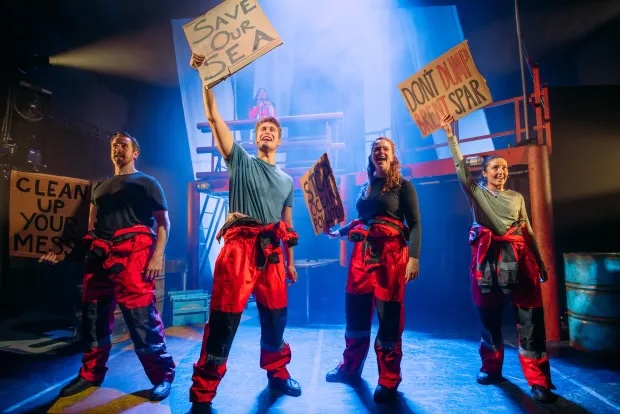
If ever I were asked to compile a list of ‘unlikely ideas for a musical,’ the story of the Brent Spar oil rig might well up there towards the top. How could such a tricky subject, set in such a obscure location, ever be convincingly staged? Well, this rousing production, written and directed by Isla Cowan and Andy McGregor is an object lesson in how to make such a venture work – a heartfelt polemic, for sure, but a supremely entertaining sung-through musical at the same time. And you don’t have to be a committed activist to appreciate the importance of what happened back in 1995 – and to realise that not enough has changed since then.

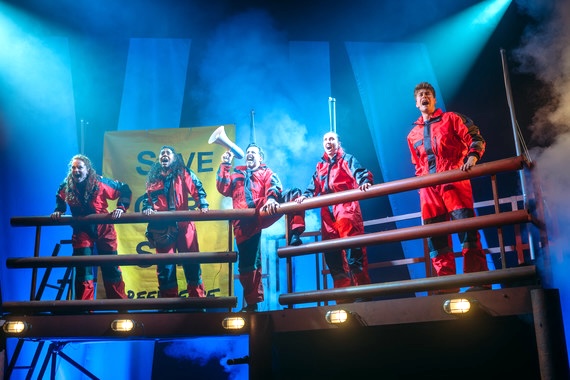
Many will remember the story of the decommissioned Brent Spar, which (largely as a cost-cutting exercise) was scheduled to be blown to bits by its owners, Shell, before being consigned to the depths of the North Atlantic, where it would cause untold damage to the ecosystem. But the company’s plans came to the attention of a team of Greenpeace activists, who sailed out from Shetland, climbed aboard the rig and steadfastly refused to leave, even after being repeatedly blasted by water cannon.

In this version of events, the names of the protagonists have been changed. Team leader Karl (Matthew McKenna) is driven by his desire to do the right thing for the environment. He’s backed up four others: feisty rich girl, Engel (Katie Weir), whose parents made a lot of money from fossil fuels; student, Colin (Nathan French), who has impulsively abandoned his University studies in order to go on this mission; journalist with a conscience, Brianna (Kaylah Copeland), who has promised to do everything she can to bring this matter to the public’s attention; and stay-at-home mum, Rachel (Kara Swinney), taking a break from her domestic duties to make a stand for ‘something that matters.’

Together the disparate team sail out to the rig and prepare to face the opposition.

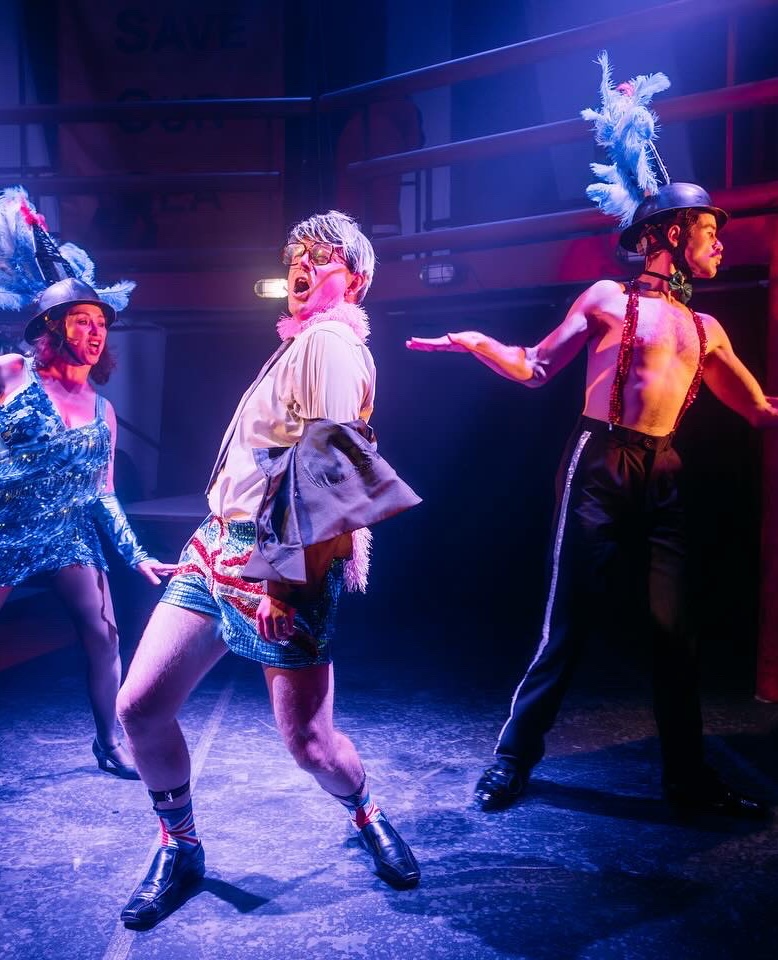
Meanwhile, a scheming triumvirate of Shell executives, Rupert (David Rankine), Karen (Helen Logan) and David (Ewan Somers), are determined to end the occupation as quickly as possible. This could cost them a lot of money! The trio are played as comic relief to the action, drawing up their dastardly plans almost in the style of Gilbert and Sullivan villains, romping around in a variety of costumes and occasionally breaking away to embody real life characters. Somers does a hilarious job of embodying John Major as (trust me) you’ve never seen him before, while Logan briefly dons a bald pate to impersonate German chancellor, Helmut Kohl.

Claire Halleran’s impressive set design convincingly evokes the rugged location and this is accentuated by Fraser Milroy’s sound and Simon Wilkinson’s lighting. The songs (also by Cowan and McGregor) are uniformly impressive, all majestic chords and soaring vocals. All the performers have impressive ranges and, when the five protestors join together in powerful harmony, the results are nothing short of spectacular. A scene where Rachel proudly proclaims the importance of her new-found role is particularly moving and I have to confess to having something in my eye by the time Swinney reaches the final chorus.

This is only at the Traverse for a couple more nights before moving on to tour a series of Scottish locations through October, finishing up in Inverness on November 2nd. If you can get seats, I urge you to make the effort. To Save the Sea is a deeply committed and ultimately moving piece of musical theatre with an important message to deliver.

4.6 stars

Philip Caveney

The Baddies

09/10/24

Lyceum Theatre, Edinburgh

The Baddies, David Greig and Jackie Crichton’s theatrical adaptation of Julia Donaldson and Axel Scheffler’s 2022 book, is well-pitched for its target audience of 3+. This morning’s audience is almost all made up of school trips, with rows of squirming, excited P1s and 2s eating snacks and being cajoled out of their jackets while waiting for the show to begin. The colourful set – designed by Jasmine Swan – intrigues them. Indeed, there’s one little girl in the front row who can’t seem to help getting out of her seat and walking towards the stage, drawn like the proverbial moth to the flame. Every time her teacher asks her to sit down, she does so – but she’s up again a moment later, eyes wide, mouth open.

But as soon as the show begins, she returns to her seat and watches, enthralled. And her reaction is a more important review of this production than anything I can write. Her classmates enjoy it too. The noise level in the auditorium bears testimony to the musical’s success: there are hundreds of young children here, clapping enthusiastically for the songs, waving their hands and shouting when required – but much quieter than the on-stage mice as the story carries them along.

A framing sequence introduces us to Mamma Mouse (Lottie Mae O’Kill), who wants to teach her three bad-mannered children (Dyfrig Morris, James Stirling and Rachel Bird) to say thank you, sorry and please, but it doesn’t go well. They’re more interested in having fun. To calm them down, she decides to tell them a bedtime story about a spotted handkerchief, and then we’re off, as they transform into the titular Baddies: Troll (Morris), Ghost (Stirling) and Witch (Bird). “We’re the very worst baddies,” they sing in the show’s catchiest number (courtesy of Joe Stilgoe) – but there’s a problem. They’re not. They’re rubbish at being bad. They can’t even scare the new young shepherdess The Girl (Yuki Sutton), who’s out in the mountains on her own for the very first time.

As an adult, I have to say that the story doesn’t do a lot for me. There’s not much of a narrative arc. I’d like the manners referenced in the opening sequence to have more bearing on the subsequent narrative. I’d also like Mamma Mouse to refrain from waving around her dirty hanky after exhorting the little mice to sneeze into it to catch the germs. But these are grown-up concerns and, as we’ve established, I’m not the target audience.

Stilgoe’s songs are light and catchy, but most of them are perhaps not sing-along-able enough for little children. I like Katie Beard’s direction: the slapstick is especially nicely done, with lots of silly near misses and amusing sound effects. O’Kill seems to be channelling Mary Poppins – and this works well for the piece, lending her a convincing authority over the proceedings, so that when she assures the audience in advance that, although there are some scary moments in the story, nothing bad happens and there’s a happy ending on its way, it’s clear that the children trust her and so relax into the tale.

But, for me – as for the little front row girl – it’s Swan’s design that steals the show. The set is a glorious riot of hidden delights, like a giant Polly Pocket, the mountainside opening up to reveal a fairytale cottage, while the costumes – although different from the book’s illustrations – seem somehow iconic. I can imagine them as popular Hallowe’en outfits.

The Baddies leaves Edinburgh on the 20th October for an extensive nationwide tour. If you’re a parent or a teacher and you have wee ones you want to treat, an hour in the company of this not-so-dastardly trio is pretty sure to please them.

4 stars

Susan Singfield

Anna/Anastasia

08/10/24

Traverse Theatre, Edinburgh

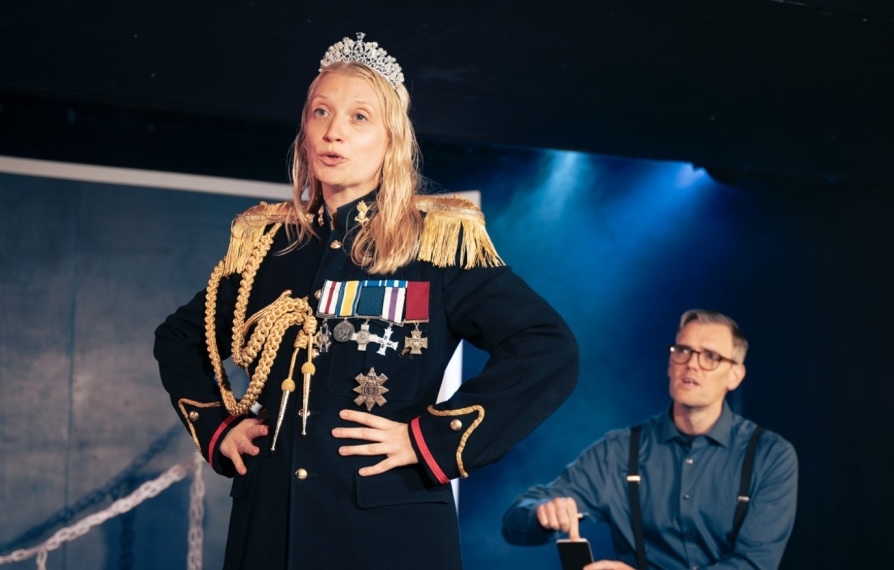
Berlin, February, 1922. Following a failed suicide attempt, Anna (Kirsty McDuff) is brought to a local police station. She’s dripping wet after trying to drown herself in a local canal. She is interviewed by Franz (Chris Forbes), a straight-laced police officer with a liking for equally straight talking. But when she claims to be the Grand Duchess Anastasia, the lone survivor of the assassination of her entire family by Bolshevik revolutionaries two years earlier, Franz isn’t quite sure what to believe. For one thing, Anna talks so lucidly about her glamorous past: her memories from the court of Nicholas and Alexandra, the glittering balls, the wonderful meals.

And for another, she is wearing an expensive-looking tiara that’s clearly been dented by a bullet…

Inspired by real events, Anna/Anastasia approaches its subject matter with an endearing sense of humour, playing Anna’s volatility off against Franz’s restrained, analytical approach. Franz, we are told, paints china swans as a hobby and keeps them up in the attic out of harm’s way. Anna, with her unrestrained bursts of exuberance, represents something he is unaccustomed to, something that threatens to bring all his most established convictions clattering down around him in pieces – and yet, as the years pass and Anna’s fortunes rise and fall, the couple keep re-encountering each other and a kind of guarded relationship develops.

The sprightly script by Jonny Donahoe (whose Every Brilliant Thing is a popular yearly visitor to the Edinburgh Fringe) maintains just the right mix of comedy and pathos, while the two performers make perfect foils for each other. McDuff stays in character the whole way through, inhabiting Anderson’s turbulent persona with considerable skill, while Forbes occasionally steps out of his main role to play a number of subsidiary characters – at one point breathlessly re-enacting the murder of the entire Romonov family single-handedly. Liz Caruthers handles the direction with an assured touch.

The story of Anna Anderson has formed the basis for many plays and films over the years and, though the mystery has recently been pretty much solved thanks to DNA testing, it continues to exert considerable powers over the public imagination. As Anna/Anastasia seems to emphasise, the actual truth of the story is somehow less important than the speculation it has always kindled – and the play’s bitter-sweet conclusion still manages to leave us wondering about the possibilities.

4.4 stars

Philip Caveney

Armour: A Herstory of the Scottish Bard

01/10/24

Traverse Theatre, Edinburgh

Today’s A Play, A Pie and A Pint production is a welcome revival of Shonagh Murray’s Armour: A Herstory of the Scottish Bard. Unwieldy title notwithstanding, this is a taut, well-scripted piece of theatre, the music deftly evoking the lyrical poetry at its heart.

It’s thirty years since the death of Scotland’s beloved poet, Robert Burns, and his widow, Jean (Irene Allan), still misses him. But she has plenty to occupy her time, not least her headstrong young granddaughter, Sarah (Karen Fishwick), who’s been sent to live with her in Dumfries, while her dad’s away in India. And then there’s Nancy Maclehose (Hilary Maclean), Burns’ erstwhile mistress, who seems very keen to talk to Jean. There’s something important she needs to say…

Tom Cooper’s direction and Heather Grace Currie’s set design both serve to highlight Murray’s clever structure, ensuring that Burns’ absence forms the centre of the play, a model of his mausoleum gleaming from the mantlepiece, white against the dark furniture. Armour is a feminist piece but it doesn’t shy away from the fact that we only know these women in relation to a man, that they are destined to remain almost unknown, circling the ghost of a famous heavyweight, as small as the dolls that Sarah plays with.

Murray’s script breathes life into the women, imagining their responses to the scant details we have of their real circumstances. Allan imbues Jean with a sharp dignity, a refusal to be shamed or diminished by her husband’s infidelities. What’s more, Maclean’s Nancy defies the image of a paramour: she admits to feeling guilt for not thinking about Jean, but there’s no room here for any moral outrage. She loved Rab. He loved her. He loved Jean too. People are complicated and you can’t change that. What you can do, as Jean explains to Sarah, is choose whether to be “a sitter or a do-er”. And being a do-er is infinitely more admirable.

Fishwick shines as the motherless young child, fascinated by her granny’s stories and determined to follow in her grandad’s footsteps and become a bard herself. Her wistful demeanour – as she remembers India and her dad – contrasts beautifully with the irrepressible spirit she shows as she sings and dances around her granny’s house. Jean and Nancy might have been consigned to a life in the shadows, but Sarah believes she can have much more. Especially with those great women behind her.

Armour is a deceptively melodic piece, which smoulders gently before bursting into full flame.

4.1 stars

Susan Singfield

The Wolves at the Door

24/09/24

Traverse Theatre, Edinburgh

The Wolves at the Door, the second in this season of A Play, A Pie and A Pint at the Traverse, is a heartfelt polemic, written by Jack Hunter and directed by Amie Burns Walker. As Winter crooks its frosty finger and beckons, this timely piece zooms in on the issue of energy companies forcing impoverished people to use expensive prepaid gas and electricity meters.

The allegory of a Big Bad Wolf threatening the security of a vulnerable Little Pig might not be subtle but it’s certainly effective, and Heather Grace Currie’s dingy set design reminds us exactly how Grimm (sorry) the situation is.

The Pig, Daniel (Ciaran Stewart), is struggling. He’s lost his job, his marriage has fallen apart and he’s desperate to maintain a good relationship with his seven-year-old daughter. But how can he do that when the flat he’s renting is mouldy and damp, and a combination of Universal Credit and part-time shelf-stacking barely leaves him enough to feed himself, let alone put the heating on? Worst of all, his daughter knows. She puts on a brave face for him, trying to reassure him that the crappy pizza he’s heated up is exactly what she wants for her tea. He can’t bear it.

Enter the Wolf, Malc (Ben Ewing), and his sidekick, Sussanne (Beth Marshall). He’s a debt collector and she’s an engineer, and they’re here at the behest of the energy company, to install a new smart meter – one that requires prepayment. If he doesn’t have the money up front, Daniel will be left without power.

Malc is unsympathetic. He knows what poor looks like; it’s how he grew up. But he believes it’s up to individuals to get off their arses and sort themselves out – like he has done. Ewing portrays the GB News-loving cynic with a charismatic swagger. “How can someone call themselves broke if they’re still drinking ground coffee, if they’ve got a TV and a Playstation?” he demands. Sussanne is less world-weary – it’s her first day – and more sympathetic too: she doesn’t think it’s a lot to ask for a warm, safe home and enough food in your belly; she’s in favour of a benefits system that allows people a few small treats. Marshall imbues the conflicted newbie with real heart – but hey, she’s got a job to do, and if she doesn’t do it, she’ll be in the same boat as Daniel.

Hunter makes some important points in this play, but the dialogue focuses too intensely on the issue, reducing the characters to representatives of their respective positions, rather than fully-rounded people. While the dark humour works well in places, a lighter touch is needed throughout to stop the story from being bogged down by its own good intentions – and perhaps the brusque conclusion ties everything up a little too neatly to be entirely convincing.

3 stars

Susan Singfield